
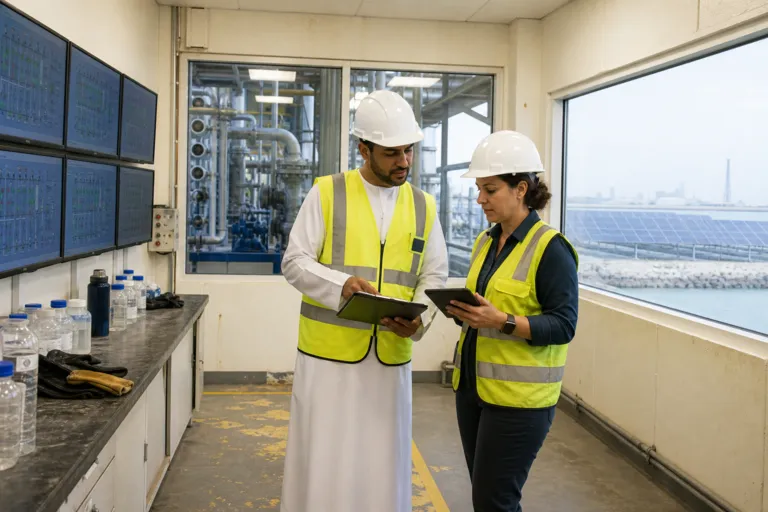
The Abu Dhabi desalination market is shaped by a simple reality across the Gulf: cities, hotels, industry, and some agriculture depend on seawater desalination for freshwater. The most common process described in the sources is reverse osmosis (RO), which removes salt by pushing seawater through ultra-fine membranes. That dependence creates a high consequence of disruption, because desalination is not a single asset. It is a chain of intake systems, treatment facilities, and energy supplies, and damage to any part of that chain can interrupt production, according to Global Water Intelligence’s Middle East editor, Ed Cullinane.
Risk awareness is not theoretical. A leaked 2008 U.S. diplomatic cable warned that Riyadh “would have to evacuate within a week” if a major plant, pipelines, or associated power infrastructure were seriously damaged. The same reporting says Saudi Arabia has invested in pipeline networks, storage reservoirs, and other redundancies designed to cushion short-term disruptions, and that the UAE has also invested in such redundancies. For Abu Dhabi, this context matters because the market’s technology choices and procurement models are inseparable from resilience planning around power, pipelines, and operational continuity.
TSE and RO Demand: Water Quality Drives Extra Treatment
Beyond municipal supply, the market is pulled by end-user water quality requirements. Arab News quotes a sector view that even where municipal desalinated water is available, facilities such as hospitals, hotels, laboratories, farms, and industrial users often require additional treatment stages to meet internal standards. Those stages can include filtration, softening, reverse osmosis, or specialized disinfection. This is where treated sewage effluent (TSE) and RO sit side by side in buyer decision-making. TSE can be part of a broader treatment and reuse chain, while RO remains a referenced tool for achieving specific quality targets within facilities.
The renewable angle is rising alongside this quality-driven demand. PV Magazine reports that solar energy is increasingly integrated into infrastructure and industrial applications in the UAE via solar-powered desalination, district cooling infrastructure, and hybrid energy systems. The same source says the UAE installed around 1 GW of solar in 2025, and that Abu Dhabi unveiled plans to support deployment of solar systems for self-consumption. For the Abu Dhabi desalination market, these signals strengthen the case for coupling water production and water treatment loads to cleaner power procurement pathways.
That coupling is reinforced by Abu Dhabi’s grid-scale renewable pipeline. Power Technology reports Masdar’s Abu Dhabi round-the-clock renewable project broke ground in October 2025 and is scheduled to commence operations in 2027. It includes 7.5 GWh of energy storage and 2.6 GW of PV inverters, with a capital investment of more than Dh22bn ($6bn). The project is expected to offset nearly 5.7 million tonnes of carbon emissions annually after coming online. While not a desalination project in the sources, it supports the broader electricity reliability and decarbonization environment that water systems depend on.
Finally, Abu Dhabi sits inside a Middle East desalination growth arc. Arab News states that between 2024 and 2028 the Middle East is projected to contract an additional 20.9 million cubic meters per day of seawater desalination capacity, 53.1% of the global total, and that by 2028 operational capacity is expected to reach 41 million cubic meters per day, a 41.6% increase from current levels. This regional pipeline does not quantify Abu Dhabi alone, but it frames how competitive procurement, RO-driven quality requirements, TSE-linked reuse pathways, and renewable-powered electricity expansion can converge in the Abu Dhabi desalination market.
What does “Abu Dhabi desalination market” mean in this article?
Which desalination process is most commonly referenced in the sources?
Why do some facilities add RO or other treatment even when municipal water is available?
What renewable project pipeline detail is reported for Abu Dhabi?
How fast is desalination capacity projected to expand in the Middle East through 2028?