


The UAE Wage Protection System 2026 update is built around a single, standardised wage deadline and a clearer enforcement sequence for private sector establishments. The UAE Ministry of Human Resources and Emiratisation (MOHRE) issued Ministerial Resolution No. 0340 of 2026 on 12 May 2026, and the framework is effective from 1 June 2026. It replaces and expressly repeals Ministerial Resolution No. 598 of 2022 and any conflicting provisions. The purpose is to strengthen compliance and ensure timely wage payments, with monitoring and enforcement now structured around defined milestones after the wage due date.
Under the new framework, salaries for the previous month are due on the first day of each Gregorian month. For example, wages earned during May 2026 must be paid by June 1, 2026, and this is also described as the first payroll cycle subject to the new deadline. The updated rules remove the former 15-day grace period during which late payments were not immediately flagged. Employers must process wage payments through the MOHRE Wage Protection System (WPS) or another MOHRE-approved payment channel, and payments are submitted via WPS files through country-registered banks or other approved platforms. The official UAE government guidance also notes wages can be paid in Emirati Dirham, or another currency if agreed in the employment contract.
Enforcement Timeline: From Day 2 Monitoring to Day 21 Legal Escalation
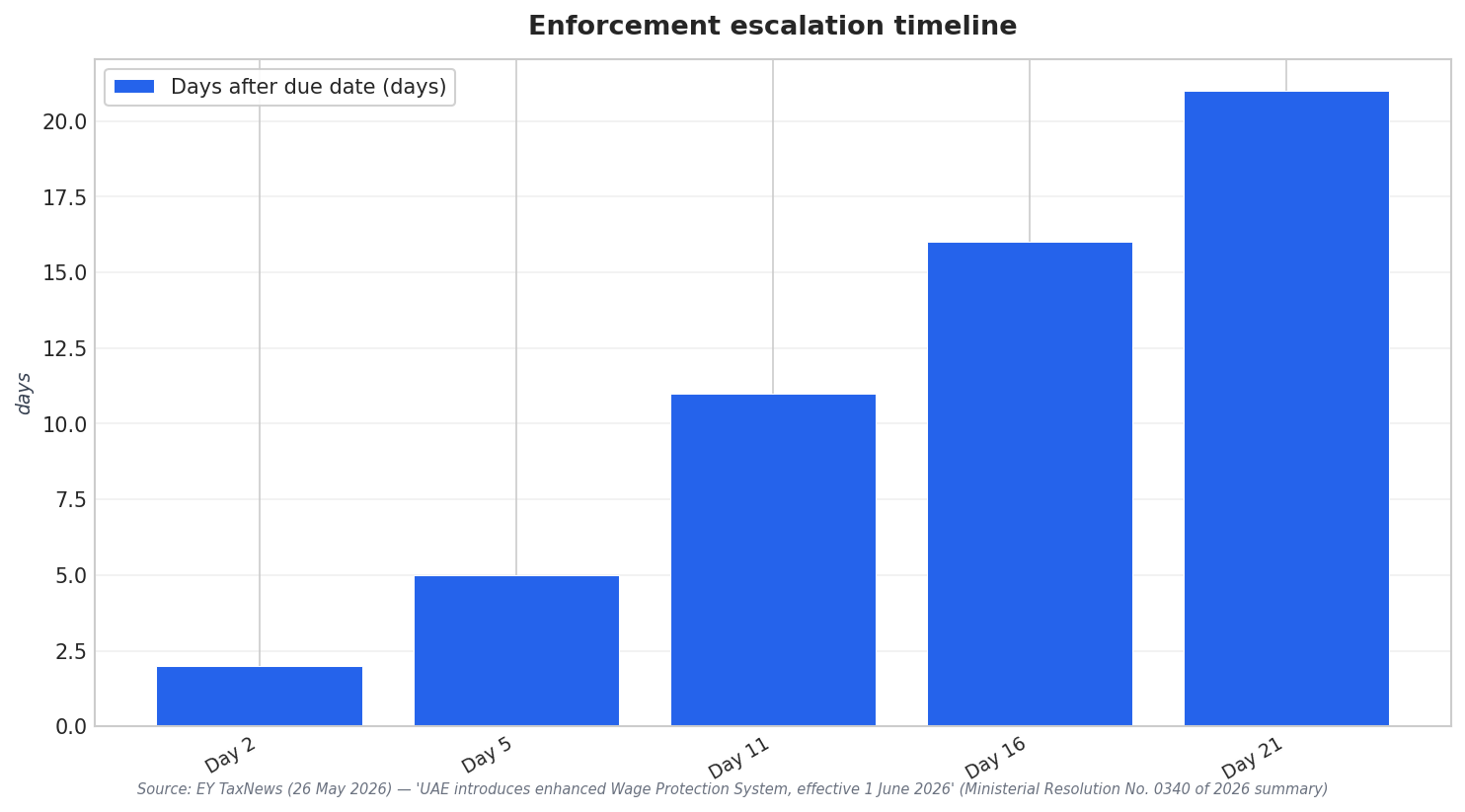
The resolution sets out gradual measures when employers delay salary payments, and the timeline starts almost immediately after the due date. MOHRE monitoring begins from the wage due date through electronic systems, with alerts and notifications issued to employers on Day 2. By Day 5, noncompliant employers face suspension of new work permits. By Day 11, administrative fines and downgrading to the Third Category can be imposed for repeated violations within a six-month period. On Day 16, labor disputes are automatically initiated, with broader permit suspensions particularly where 25 or more workers are affected (in all sectors or in specified sectors). By Day 21, the process can move to legal escalation, including asset attachment, travel bans, and referral to the public prosecution.
Beyond timing, the rules also introduce compliance thresholds and documentation expectations that employers should build into payroll controls. Guidance highlights that at least 85% of total wages should be paid on time to meet compliance thresholds, and supporting documents and data should be submitted to MOHRE to evidence wage payments under the prescribed rules. Related guidance also notes that employees receiving at least 85% of their entitled salary may not automatically be classified as unpaid where lawful deductions are properly documented. Separately, while UAE Labour Law allows deductions of up to 20% of salary in certain circumstances, and up to 50% if there are multiple reasons, the new resolution will practically restrict deductions to a maximum of 15% of an employee’s monthly wage for WPS compliance.
For employers, the operational message is simple: reset payroll calendars and test the full payment workflow before each due date. The employer remains ultimately responsible for timely wage payment and compliance, even if payroll is supported by banks or other platforms. Businesses should confirm whether each establishment in the group is registered with MOHRE and check whether any free-zone entities require separate compliance checks under their respective authority. Internal teams should be briefed that delays can be detected from Day 2 and escalate through permit suspensions, fines, company downgrading, disputes, and potential legal steps by Day 21. Workers with concerns can contact MOHRE or register a salary complaint through official channels.
When do the new UAE wage payment rules take effect?
What is the salary due date under the 2026 wage protection update?
How fast can enforcement escalate after a late payment under the updated WPS?
What does employer compliance mean in practice for the UAE Wage Protection System 2026?
Do the 2026 rules change how deductions affect WPS compliance?