
Young households are changing how daily essentials are purchased and evaluated in the Abu Dhabi baby products market. Across the UAE, online retail is described as the fastest-growing distribution channel for baby care products, with subscription models and same-day delivery reshaping replenishment behavior. At the same time, regulators influence what sits on shelves. MarkWide Research notes that MOHAP enforces cosmetic and personal care standards with safety assessments, ingredient transparency, and adverse event reporting for baby care items, while ESMA administers conformity certification requirements for labeling, shelf-life claims, and packaging safety. These pressures encourage brands to requalify suppliers and tighten formulation cycles.
For infant nutrition, the UAE market for food preparations for infants is structurally import-dependent. IndexBox estimates that 85–95% of products are sourced from international manufacturers across Europe, Asia-Pacific, and North America, reflecting limited domestic production capacity. In the same report, infant formula and milk-based preparations dominate the category, accounting for an estimated 55–65% of total market value. IndexBox also links demand to a stable newborn cohort of approximately 95,000–105,000 annual births and a high expatriate population share exceeding 88%, alongside strong purchasing power among dual-income households in Dubai and Abu Dhabi. Premium and organic infant food preparations are reported to command price premiums of 30–60% over standard products.
Diapers and Wipes: Premiumization, Hospitals, and Fast Delivery
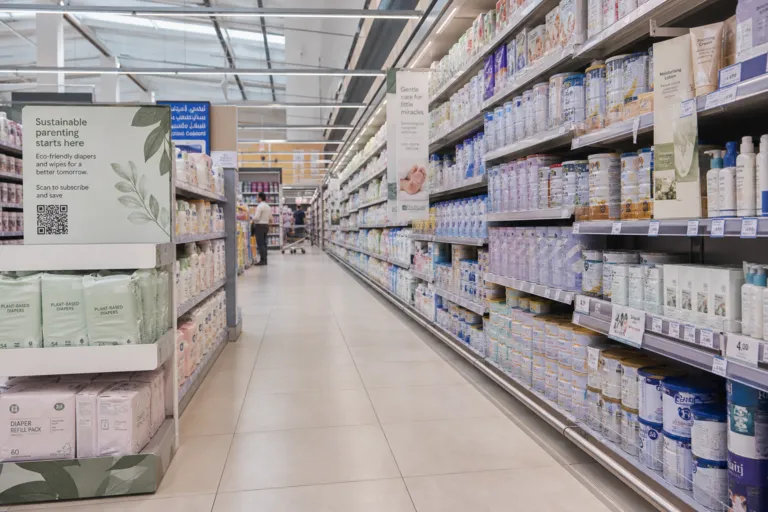
Diapers and wipes remain a core, high-frequency purchase, and multiple sources describe an ongoing shift toward premium, eco-friendly, and skin-friendly choices. Mordor Intelligence values the UAE baby diapers and wipes market at USD 116.5 million in 2026 and projects a CAGR of 4.53% to reach USD 145.38 million by 2031. The same source lists major companies including Kimberly-Clark Corporation, Kao Corporation, Unicharm Corporation, Procter & Gamble Company, and Essity AB. MarkWide adds that disposable diapers command the largest volume share due to convenience preferences among working parents, while biodegradable diapers are described as the fastest-expanding category as MOHAP encourages sustainable material transitions and creates preferential shelf placement for compliant products in major retail chains.
Abu Dhabi also has distinct demand signals tied to healthcare procurement and climate-focused product engineering. MarkWide reports that Kimberly-Clark anchors its position through hospital supply contracts with Abu Dhabi’s maternity networks, while Abu Dhabi maternity hospitals are specifying next-generation bio-based superabsorbent polymer (SAP) materials in procurement tenders. In baby care more broadly, MarkWide highlights “millennial caregiver premiumization,” stating that Dubai and Abu Dhabi households demonstrate sustained willingness to pay for organic-certified formulations, pulling premium skincare lines into hypermarket shelf resets. Nexdigm similarly notes that Dubai and Abu Dhabi dominate the UAE baby diapers market due to high population density, an affluent consumer base, and modern retail infrastructure, alongside growing preference for premium, eco-friendly diaper options.
Premium demand is not limited to individual categories, and retail investment reflects that momentum. Ken Research values the UAE premium baby care retail market at USD 1.2 billion and links growth to rising incomes, expatriate growth, and heightened awareness of high-quality baby products, with Dubai and Abu Dhabi described as dominant cities. Mordor Intelligence also points to localization momentum: in February 2026, AD Ports Group announced that Barakat Group started construction of an AED 150 million baby food manufacturing facility in Khalifa Economic Zones Abu Dhabi (KEZAD). For young families, this combination of premiumization, tighter compliance, and faster digital fulfillment is shaping how formula, diapers, and skincare brands compete in Abu Dhabi and across the UAE.
How is the Abu Dhabi baby products market changing for young families?
How import-dependent is infant formula and baby food in the UAE?
What are the key numbers for the UAE baby diapers and wipes market?
Why are premium and eco-friendly baby products gaining traction?
What localization investment was announced for baby food manufacturing in Abu Dhabi?