Electric vehicle charging in Abu Dhabi is increasingly discussed as a system build-out rather than a niche amenity. A scenario-based planning study focused on Abu Dhabi develops a framework that combines charging-demand estimation, economic feasibility analysis, and spatial equity assessment for urban and rural regions through 2050. It highlights a core challenge for the emirate’s planners: dense metropolitan cores exist alongside sparsely populated rural communities across large geographic areas, with uneven population distribution and varying levels of grid readiness. The study also warns that inadequate charging coverage can be a key barrier to user confidence, especially where coverage and access are uneven.
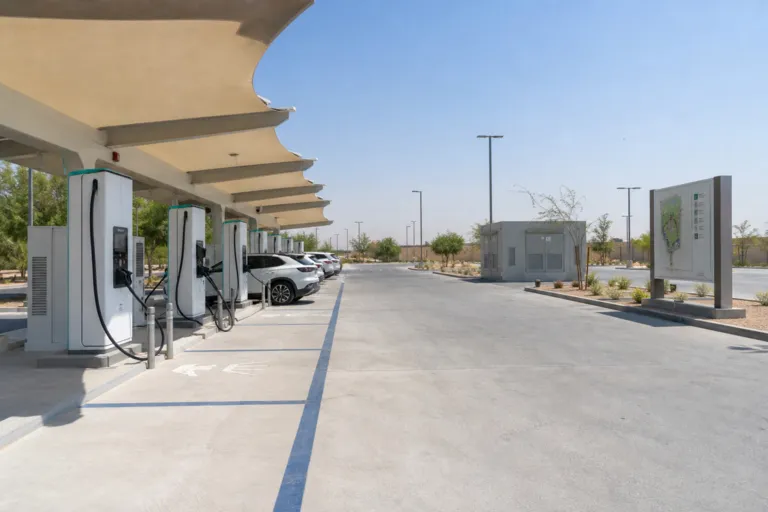
On deployment commitments, UAE-wide market reporting cites Abu Dhabi’s announced plan to add 1,000 charging stations across 400 locations. That target sits alongside other UAE network signals that shape expectations for equipment, operations, and user behavior. The same source cites more than 620 public charging stations active across the UAE and describes a deployment model where utilities, oil and gas companies, and private charge point operators all participate. For Abu Dhabi, this matters because a rollout measured in hundreds of sites implies site acquisition, grid connections, and operating discipline, not just charger installation.
Operator Models Are Shifting Toward Utilization, Not Visibility
As networks expand, operator strategy is increasingly framed around utilization risk. UAE charging commentary notes a trade-off between visibility and viability, where a charger can look impressive on paper while remaining commercially underused for years. It also points to the growing relevance of fast and ultra-fast charging along highway corridors, specifically the Abu Dhabi–Dubai corridor, because intercity reliability addresses confidence on longer trips. In early 2026, ADNOC Distribution opened one of the world’s largest superfast EV charging hubs on the E11 highway between Abu Dhabi and Dubai, reinforcing the role of corridor charging in day-to-day mobility.
Fleet electrification is a second demand pillar with concrete procurement mechanics. Market research on the UAE’s hybrid and electric vehicle landscape describes how leasing providers and energy service companies are capturing fleet relationships that were previously held by traditional dealers. It says this concentration is most visible in Abu Dhabi’s government-related entities, where Etihad Esco and Masdar joint ventures specify 10-year operating contracts that bundle vehicles, charging, and maintenance. The same source adds that Abu Dhabi Department of Energy charging standards include unified technical specifications for fast-charging infrastructure, reducing deployment friction and accelerating network density along commercial corridors.
Rental and chauffeur segments provide another practical signal because they turn charging into routine behavior. An Abu Dhabi-focused outlook references UAE-wide indicators of about 2,000 public EV charging points as of 2023 and cites industry data that EV and hybrid vehicles are about 5% of total UAE rental fleet inventory, with expectations that this share will grow as charging expands. Separately, UAE policy direction sets a long-term ambition: under the National Electric Vehicles Policy, the UAE aims to increase the share of electric vehicles to 50% of total vehicles on UAE roads by 2050. In combination, these signals frame how the Abu Dhabi EV charging market may be judged over time: not only by station counts, but by everyday usefulness across homes, workplaces, fleets, and high-utilisation locations.
What rollout target has Abu Dhabi announced for public EV charging?
How are operator models evolving as charging expands in Abu Dhabi and the UAE?
What fleet trend is shaping demand in Abu Dhabi?
What do rental fleets indicate about near-term charging demand?
What key planning issue defines the Abu Dhabi EV charging market over the long term?