
Planning for the Abu Dhabi home furnishings market starts with what is driving purchase cycles on the ground: move-ins, relocations, and housing turnover. Nexdigm links UAE demand to “high relocation activity, apartment rentals, villa occupancy, expatriate household formation and premium home-upgrade demand,” and notes that Dubai and Abu Dhabi’s residential real estate activity supports regular move-in furnishing cycles. That pattern spans core categories such as beds, wardrobes, sofas, mattresses, dining sets, curtains, rugs, and outdoor seating. In parallel, Mordor Intelligence frames UAE momentum around a “surge in residential handovers across Dubai and Abu Dhabi,” plus a hospitality boom and industrial policies that encourage local manufacturing and supply-chain localization.
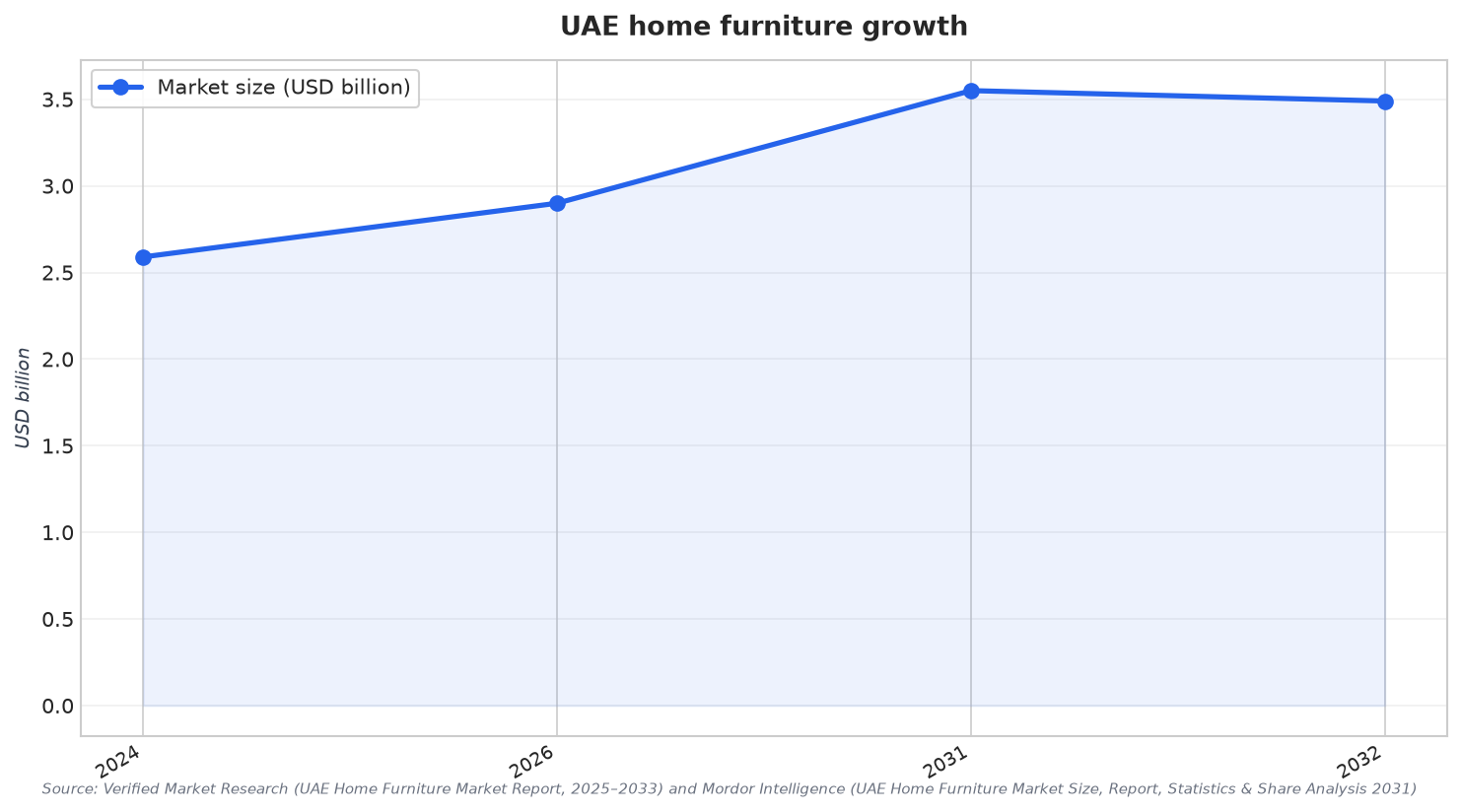
National figures provide important context, but they must be read as UAE-wide rather than Abu Dhabi-only. Verified Market Research estimates the UAE home furniture market at USD 2.59 billion in 2024, reaching USD 3.49 billion by 2032, at a 3.80% CAGR from 2025 to 2032. Mordor Intelligence estimates USD 2.78 billion in 2025 for UAE home furniture, growing to USD 3.55 billion by 2031, at a 4.15% CAGR (2026–2031). Within that same UAE home furniture view, bedroom furniture held 27.95% share in 2025, wood accounted for 69.98% share in 2025, and mid-range products represented 48.35% share in 2025, while premium furniture is projected to grow at a 5.78% CAGR through 2031.
Online Channels and Omnichannel Retail: What Changes by 2027
Digital purchasing is a key theme for retailers preparing for 2027, especially because UAE home furniture data points to faster growth online than in many other channels. Verified Market Research highlights that e-commerce platforms, customization options, and swift delivery services provided by online retailers are driving UAE market expansion. Mordor Intelligence reports that, in UAE home furniture, specialty stores held 43.92% of revenue in 2025, while the online channel is poised for the fastest expansion at a 6.83% CAGR to 2031. At the GCC level, Mordor also notes that IKEA’s small-format locations in Abu Dhabi and Fujairah (opened in August 2024) support omnichannel fulfillment and click-and-collect behaviors, reinforcing the blend of physical and digital journeys that can influence purchasing across the emirate.
Household formation and housing turnover can translate into measurable demand signals, even when the underlying statistics are reported for Dubai or the UAE overall. Mordor Intelligence cites a 34% jump in Dubai real-estate sales value to AED 151 billion in 2024, and also points to rising rents—18% for short-term and 13% for long-term leases—as factors that can push residents toward ownership and “complete refurnishing cycles.” It also references population growth above 12% as adding incremental households that buy full suites. For Abu Dhabi retailers, the practical takeaway is not to treat those Dubai figures as local numbers, but to use them as a directional read on how turnover and tenure shifts can accelerate furniture refresh cycles, especially when paired with rent-to-furnish packages and subscription services highlighted in the UAE home furniture analysis.
Looking toward 2027 demand drivers, several policy and product signals stand out in the sources. In the UAE, e-invoicing becomes mandatory for B2B and B2G transactions from July 2026, and Mordor expects this to streamline order-to-cash processes for furniture retailers and enable tighter integration of online storefronts with warehouse and store inventories. MarkWide Research adds that ESMA mandates stricter fire-resistance ratings for residential furnishings, influencing what can be sold and how fast certain components clear certification timelines. On the market side, Mordor’s broader UAE furniture report predicts Abu Dhabi will record the fastest growth among emirates at a 5.60% CAGR over 2026–2031, while emphasizing that steady household formation and expanding digital retail platforms help brands extend reach beyond destination showrooms.
What is shaping the Abu Dhabi home furnishings market ahead of 2027?
How fast is online furniture retail expected to grow in the UAE context?
Which product and material segments are most prominent in UAE home furniture data?
What policy or compliance changes matter for furniture retailers from 2026 onward?