

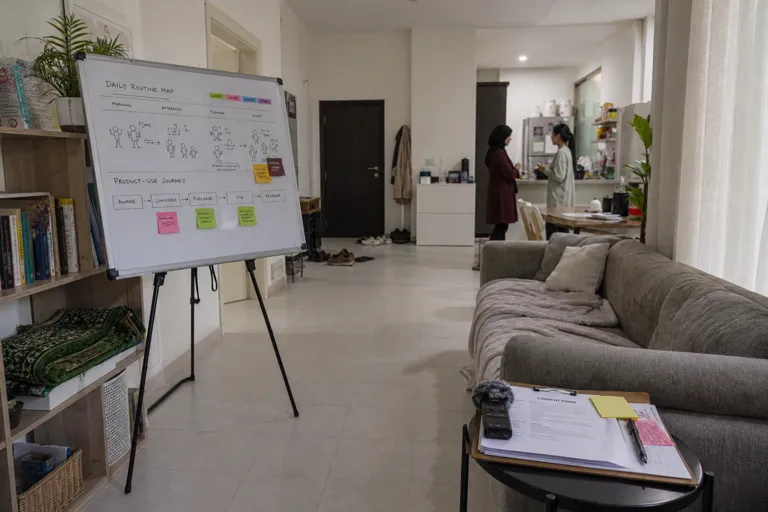
In Abu Dhabi, consumer reality is shaped by a country built on diversity and fast change. The UAE was founded in 1971 and is made up of seven emirates, with Abu Dhabi and Dubai the most important in economic terms. A 2024 population estimate puts the UAE at 10.9 million, with Abu Dhabi listed at 1.6 million. Research teams need to recognize that Emiratis make up fewer than one in five of the population, while the largest expatriate communities are from India, Pakistan, and Bangladesh, followed by the Philippines, and Western expatriates are estimated at around 8% of the total. This mix is why in-home observation can be so valuable: the “same” category can be bought, used, and discussed differently across households.
Ethnographic work is designed for this kind of complexity because it studies people in context. Think Positive describes ethnography as observing how people interact with products, services, and brands in their daily lives, to understand cultural influences and decision-making in real-world settings. Their approach blends in-person observation with digital ethnography, interviews, and supporting methods, rather than relying only on what consumers say. That is especially relevant when brands want to learn everyday routines, shopping habits, and product usage as they naturally happen. When a household is multicultural, those routines may include different languages, different reference brands, and different expectations for service, packaging, and value, all of which can be missed if you only run a discussion in a research facility.
How to Design Household Ethnography for Abu Dhabi’s Multicultural Reality
Good household observation does not replace other tools; it connects them. FieldworkHub positions the UAE as a market where both qualitative and quantitative research are common, from in-depth interviews to focus groups. Averty also points to mobile ethnography, which combines digital tools with traditional ethnographic approaches to understand behavior in natural settings, and notes that in-store intercepts in shopping malls can fit Middle Eastern consumer culture. For Abu Dhabi specifically, a Usage and Attitude (U&A) study can add structure, because it captures what people do and what people feel about a category and can include some sizing to prioritize opportunities. Used together, ethnography gives the “why,” while U&A and other quantitative work help decide what to prioritize next.
This is also where culture-first segmentation becomes practical rather than theoretical. Titan Digital UAE describes ethno-marketing as adapting positioning, language, imagery, and channels to the cultural identity of a specific community, supported by ethnographic research, and going beyond simple translation. The same source frames a key creative risk: diverse casting without community insight can be read as token casting, and “diverse” visuals can backfire if the message is generic or detached from lived behavior. Ethnographic research in the UAE helps prevent that by showing what “trust” looks like inside the home: what gets used daily, what gets kept for guests, what gets shared in family groups, and what is rejected even when people claim to like it.
Finally, ethnography becomes more actionable when brands connect it to broader consumer behavior analysis. Aviaan describes the UAE as dynamic and rapidly evolving, shaped by a multicultural population, high disposable income, and tech-savvy consumers, and emphasizes combining qualitative and quantitative research alongside digital analytics and predictive modeling. Think Positive similarly highlights combining observation with online surveys and digital tracking for deeper feasibility work and more authentic insight. The practical takeaway is sequencing: start with household observation in Abu Dhabi to uncover real routines and social context, validate patterns with broader research, and then build messaging and customer experience that respects each community’s cultural logic without flattening it into one “UAE consumer.”
What does ethnographic research in the UAE actually observe inside households?
Why is Abu Dhabi household research so sensitive to multicultural dynamics?
How can ethnography be combined with other methods for stronger decisions?
How does ethno-marketing connect to ethnographic insight in the UAE?