
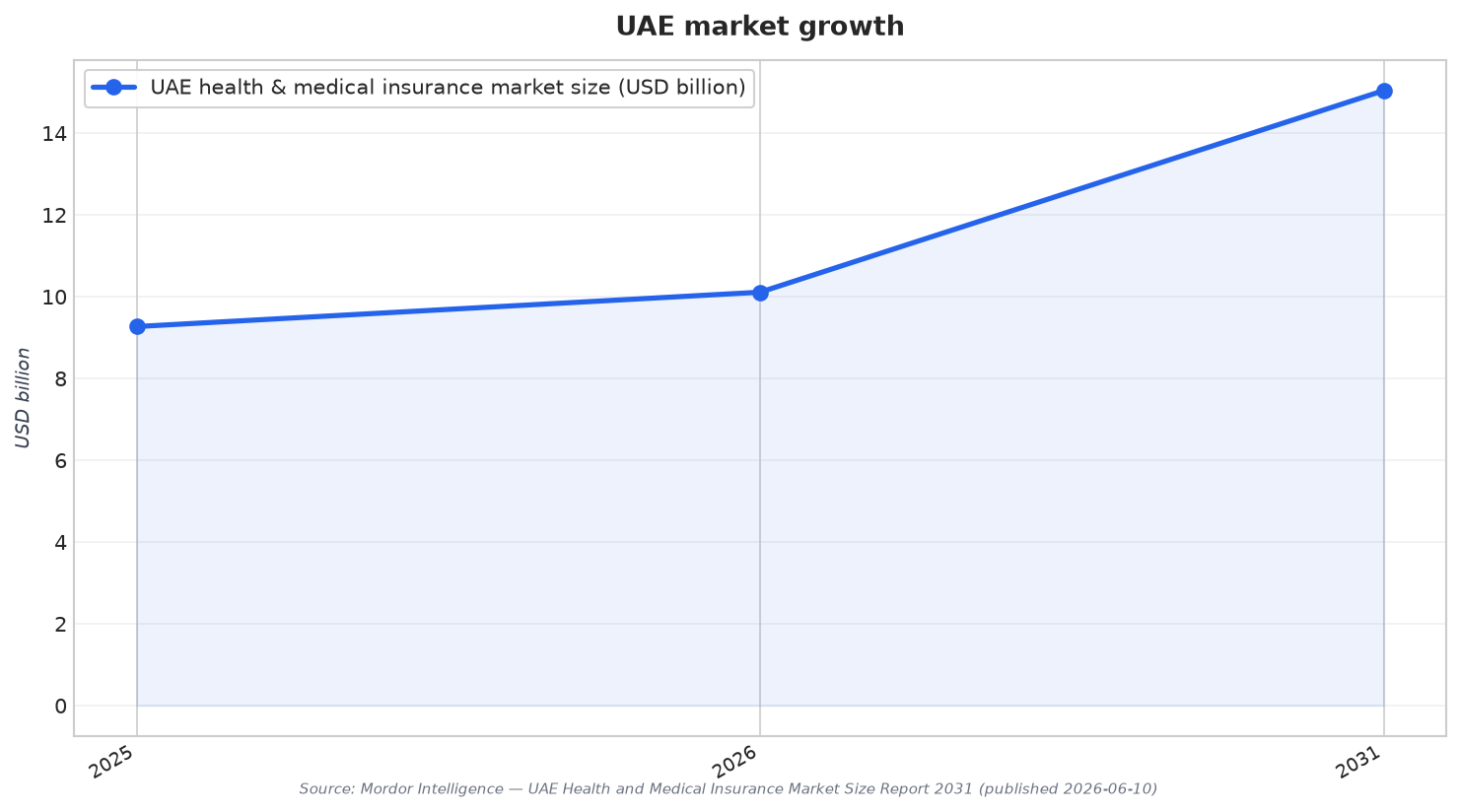
Abu Dhabi’s health insurance landscape sits within a national market that multiple research sources forecast to grow over the rest of the decade. Mordor Intelligence estimates the UAE health and medical insurance market will rise from USD 9.27 billion in 2025 to USD 10.11 billion in 2026, and reach USD 15.04 billion by 2031 at an 8.26% CAGR for 2026–2031. IMARC also values the UAE health insurance market at USD 9.3 billion in 2025 and projects USD 15.4 billion at a 5.62% CAGR for 2026–2034. These UAE-wide figures matter for anyone planning in Abu Dhabi because the emirate is a core enforcement and issuance center under mandatory coverage rules, and demand is reinforced by an expatriate-heavy population base across the country.
Mandatory coverage is the most decisive trend affecting benefits design, pricing pressure, and member volumes. Mordor Intelligence reports that mandatory policies held an 86.22% share of the UAE market in 2025, while group policies led by insurance type with a 72.69% share in 2025. A nationwide mandate effective January 1, 2025 requires employers to fund health insurance for private-sector staff and domestic workers, and sets a basic package priced at AED 320 (USD 87.11) per year with no waiting period for chronic diseases. Other UAE research covering home healthcare links this same AED 320 (USD 87.0) compulsory basic coverage to expanded access for around 3 million workers and cites co-payments of 20% for inpatient and 25% for outpatient episodes, alongside no waiting periods for pre-existing conditions. In practice, this pushes more covered lives into regulated pathways and shifts competition toward network performance and claims outcomes, not only premium rates.
Payer Dynamics and Distribution: Where Power Concentrates
Payer mix and distribution channels shape how providers in Abu Dhabi get paid and how patients access care. Mordor Intelligence finds private insurers dominated the UAE market with a 92.64% share in 2025, and brokers and agents controlled a 66.89% share of distribution that year, while online platforms are expected to post the fastest growth at a 13.87% CAGR through 2031. MarkWide Research adds that Abu Dhabi and Dubai together concentrate the bulk of policy issuance and premium collection, and describes a structural divide between government-linked coverage and contested private corporate accounts. It cites examples of network strategies: Daman Health’s government-linked positioning via the Department of Health Abu Dhabi affiliation, contrasted with multinational carriers that emphasize different approaches, such as premium hospital chain direct-billing control or specialized corporate wellness bundling. For providers, this mix means contracting must address both broker-driven employer negotiations and payer-led utilization controls.
Provider network strategies in Abu Dhabi increasingly rely on digital interoperability and on service lines that absorb mandate-driven utilization. Mordor Intelligence highlights Abu Dhabi’s Malaffi health information exchange, describing it as connecting all hospitals and a large network of clinics and clinicians, enabling payers to strengthen adjudication and utilization management. At the same time, early insurance data referenced in UAE home healthcare research indicates increased utilization of home nursing visits after the 2025 compulsory rollout, signaling demand that had been suppressed by cost barriers. For network planners, that points to tighter referral management, stronger post-acute pathways, and contracts that align documentation and care coordination with payer expectations in a more data-liquid environment.
One practical way to position the Abu Dhabi health insurance market for sustainable growth is to build networks that match where reimbursed volumes are expanding. UAE home healthcare sources project the UAE home healthcare market will grow from USD 1.18 billion in 2025 to USD 1.31 billion in 2026 and reach USD 2.19 billion by 2031, a 10.84% CAGR for 2026–2031. They also report rehabilitation therapy services accounted for 37.74% of the UAE home healthcare market share in 2025, and that clinical management systems captured 51.92% share in 2025, with agency software platforms forecast to grow at a 10.96% CAGR through 2031. For Abu Dhabi providers negotiating with payers, this supports strategies that expand home-care capacity, formalize rehab pathways, and invest in systems that keep utilization review, clinical documentation, and claims readiness aligned with mandate-driven plan designs.
What is changing fastest in Abu Dhabi’s health insurance landscape?
How dominant are group policies in the UAE system that Abu Dhabi operates within?
Who holds the most power in payer dynamics and distribution channels?
How can providers adjust their network strategies as utilization rises?