
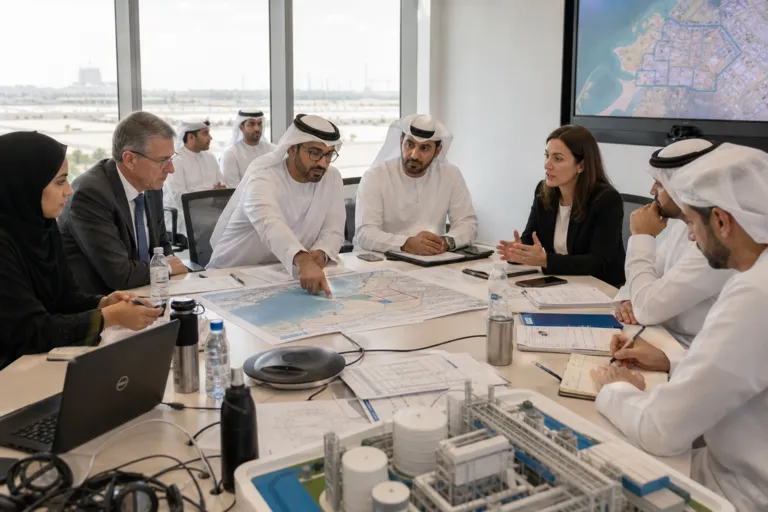
Water security is being treated as a development priority and an economic risk at the same time. In early 2026, the Abu Dhabi Fund for Development (ADFD) launched the Abu Dhabi Global Water Platform, describing it as a landmark initiative designed to place water security at the center of development and diplomacy. The platform is designed to mobilize up to $2 billion (AED7.34 billion) from local and international financing institutions, with ADFD allocating an initial $1 billion (AED3.67 billion) over five years from 2026 to 2030. Across developing economies, the initiative targets around 10 million beneficiaries, focusing on access to clean and safe water, stronger water and food security, and the adoption of advanced technologies for better water resource management.
The timing reflects wider pressure on water systems globally. Fanack Water notes rising risks for vulnerable communities from climate change, population growth, and weak water infrastructure, making partnerships, finance, and innovation more urgent. The platform is also positioned as a practical way to support United Nations Sustainable Development Goal 6, which calls for universal access to clean water and sanitation by 2030. In related global context, the UN Development Programme warns that by mid-century, at least one in four people could face recurring water shortages if current trends continue. For ADFD, the platform is also a pillar of its 2030 strategy, with focus areas tied closely to water outcomes, including food security, energy, and agriculture.
From Global Finance to National Resilience
Abu Dhabi’s approach also includes national system planning. In June 2026, the Abu Dhabi Department of Energy launched a national resilience framework during the third Water and Energy Majlis. The framework is structured around three core pillars: infrastructure, human capital and governance, and technology and innovation. It sets out 15 strategic measures to strengthen the resilience, reliability, and efficiency of the national system. At the federal level, the UAE Water Security Strategy 2036 aims to drive demand optimization through sustainable desalination, particularly through the widespread adoption of advanced reverse osmosis systems, linking water planning to long-term operational efficiency and technology choices.
International engagement is being used to complement these domestic efforts. At Abu Dhabi Sustainability Week 2026, the Ministry of Foreign Affairs convened governments, investors, and civil society to advance global water action ahead of the 2026 UN Water Conference, which the UAE will co-host with Senegal. Officials framed water as more than a development issue, describing it as a growing climate and economic risk that requires coordinated investment, stronger governance, and effective public–private partnerships. The Global Water Platform also goes beyond physical assets by supporting scientific research, youth-led initiatives, and knowledge sharing, alongside project financing and cooperation agreements intended to implement high-impact water projects.
Technology and sustained investment are recurring themes in how water scarcity is being reframed into resilience. Khaleej Times points to the UAE’s own experience as a case study, stating that more than 40 per cent of its potable water is derived from desalination and citing that over Dh7.3 billion (nearly $2 billion) has already been allocated to new desalination facilities, according to the Dubai Multi Commodities Centre (DMCC). Read together with the resilience framework’s focus on infrastructure and innovation, and the global platform’s $2 billion mobilization target, the Abu Dhabi water security strategy can be understood as a combined playbook: finance and diplomacy abroad, and structured resilience planning and technology pathways at home.
How much financing is the Abu Dhabi Global Water Platform designed to mobilize, and over what period is the initial commitment?
Who are the intended beneficiaries of the platform, and how many people could it reach?
What are the main focus areas of the Abu Dhabi Global Water Platform?
What does the UAE Water Security Strategy 2036 emphasize for demand optimization?
What does the Abu Dhabi water security strategy include beyond global financing?