
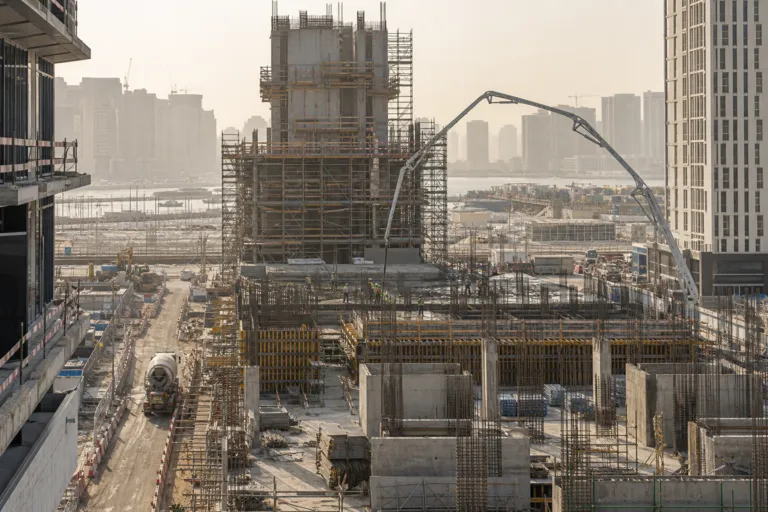
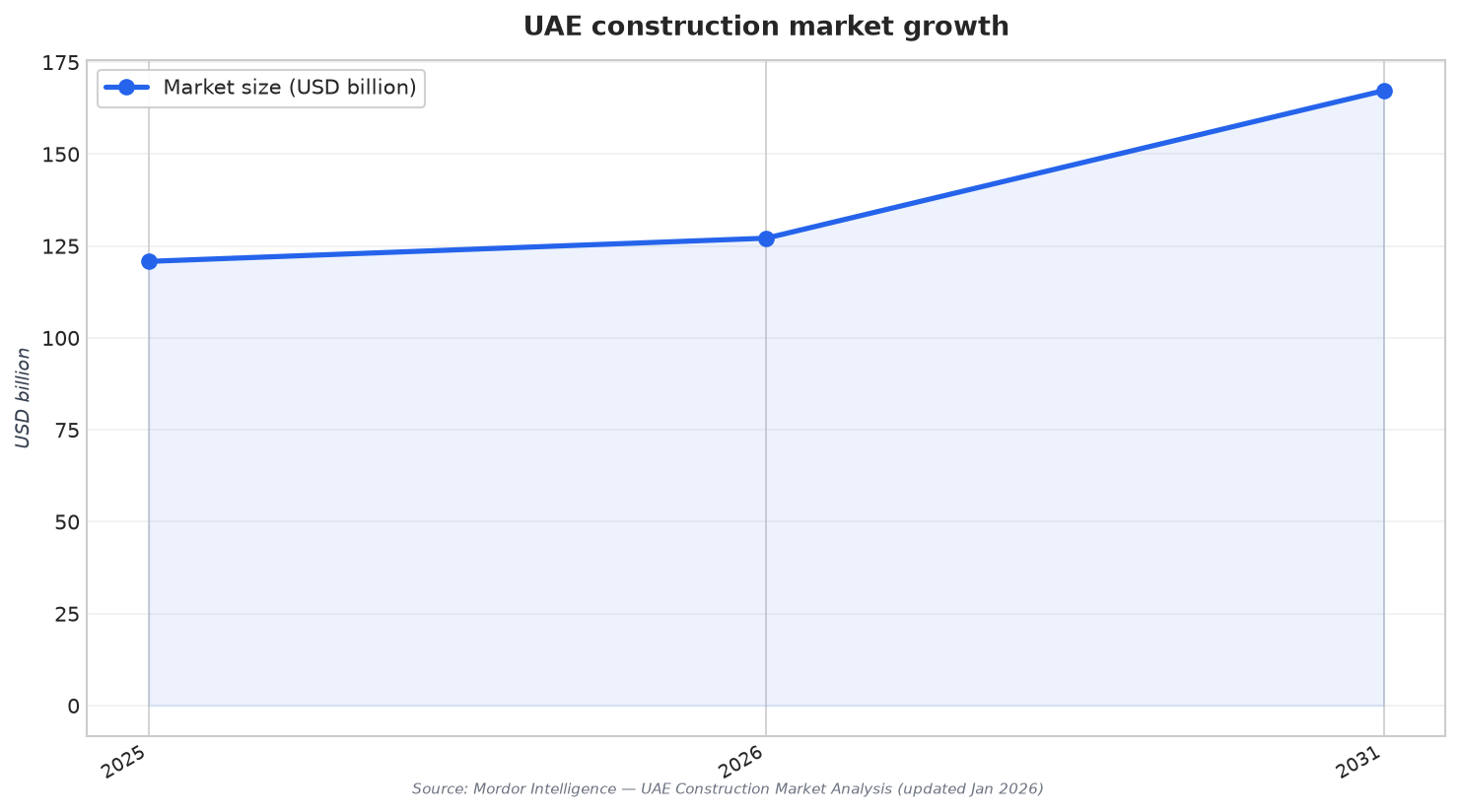
The Abu Dhabi construction market enters 2026 with a more predictable pipeline than many regional peers, helped by long-range public programs. Mordor Intelligence frames this stability as linked to public investment under Vision 2031 and emirate masterplans, including Abu Dhabi Economic Vision 2030. In that context, the UAE construction market is projected at USD 127.13 billion in 2026, up from USD 120.82 billion in 2025, with USD 167.27 billion projected by 2031 (Mordor Intelligence). These UAE-wide figures are not Abu Dhabi-only, but they help explain why contractors active in the capital can plan capacity with more confidence than in a purely cyclical tender environment.
Abu Dhabi-specific spending plans sharpen that visibility. Mordor Intelligence cites Abu Dhabi’s USD 65.3 billion infrastructure envelope, describing a sequenced slate of roads, housing, and renewable assets. Separately, ResearchAndMarkets.com coverage of a UAE construction industry report highlights an Abu Dhabi government AED240 billion ($65.4 billion) investment plan announced in December 2025, aimed at housing, transportation, healthcare, and education over the next seven to ten years. On the project side, the same report points to the Khazna Solar PV Project in Abu Dhabi with 1.5GW capacity, plus the AED2.6 billion ($700 million) UAE-Oman power link project. For contractors, that blend supports both civil and MEP demand, and it increases the value of being qualified for energy and utilities packages alongside buildings.
Cost Pressures and Procurement Shifts That Define 2026
Growth does not remove pressure from delivery. GlobalData flags near-term headwinds for the UAE construction industry, including regional geopolitical tensions, supply chain and logistics disruptions, and heightened prices for construction materials and oil. MEED’s UAE Projects Market 2026 report echoes this, stating that rising costs, supply chain constraints, and competitive pressures continue to impact project delivery, even as projects progress with structured planning and risk management. In response, MEED notes more flexible procurement strategies, long-term partnerships, and integrated delivery models to manage risk and maintain progress. Mordor Intelligence adds an execution angle, noting a shift toward modular methods and integrated supply-chain strategies as credit conditions tighten and material costs remain elevated.
Contractor outlook for 2026 also depends on where demand is strongest. Mordor Intelligence reports that, across the UAE, residential building captured 43.8% of market share in 2025, while infrastructure is forecast to post the fastest 5.23% CAGR through 2031. New-build activity accounted for 76.9% of 2025 value, and conventional on-site methods held 74.3%, but modular approaches are expanding at a 6.54% CAGR. Investment dynamics matter for bid strategy too: private outlays formed 65.1% of 2025 spending, while public spending is projected to rise at a 5.90% CAGR through 2031. For Abu Dhabi delivery teams, these UAE-wide signals support a 2026 playbook built around infrastructure capability, modular readiness, and tighter supply-chain control.
Financing conditions and broader industrial policy add another layer to the 2026 outlook. ResearchAndMarkets.com cites that interest rates remained unchanged at 3.65% in January 2026 (CBUAE) and that total bank credit to construction and real estate reached AED273.1 billion ($74.4 billion) at the end of Q3 2025, up from AED264.8 billion ($72.1 billion) at the end of Q2 2025. GlobalData also notes a government goal to increase the nation’s GDP from approximately AED1.7 trillion ($462.9 billion) in 2024 to AED3 trillion ($816 billion) by 2031, and highlights AED180 billion ($49 billion) in new industrial procurement opportunities unveiled in April 2026 to localize over 5,000 key industrial products by 2030. For contractors, the message for 2026 is clear: pipeline strength can support growth, but winning and delivering work will hinge on procurement discipline, risk allocation, and proven execution under cost pressure.
What supports the project pipeline in Abu Dhabi heading into 2026?
Which Abu Dhabi energy project is highlighted in the sources?
What cost and delivery pressures are shaping contractor decisions in 2026?
How do UAE-wide sector trends inform strategy for the Abu Dhabi construction market?
What financing signals in the sources matter for 2026 contracting momentum?