
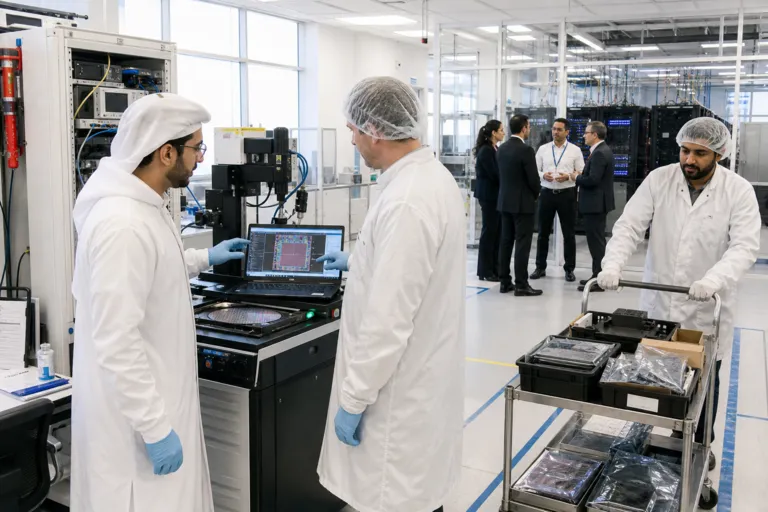
The UAE semiconductor strategy is being shaped by a global market that is increasingly defined by geopolitics, export controls, and the scramble to secure trusted supply chains. One market view describes a “$697B industry” opportunity set where growth depends on domestic foundries, AI-chipmakers with diversified revenue, and allied market partnerships, including demand in the UAE, India, and Europe. In this context, the UAE is not positioning itself only as a buyer of advanced chips. It is working to become an allied, investable node in the broader value chain through industrial capacity building and targeted technology partnerships.
Alliances matter because restrictions can redirect where technology and capital flow. A May 2025 U.S.-UAE AI chips deal is described as a flagship example of this realignment, including licensing frameworks for AI chip exports. At the same time, the same market analysis argues export controls can stifle access to markets but also accelerate domestic production and diversification through strategic alliances. Abu Dhabi’s pitch fits this moment: be a dependable partner market that can absorb AI demand while building complementary industrial and research capabilities that align with allied supply chains.
From AI Demand to Industrial Scale in Abu Dhabi
Abu Dhabi is tying chip access to applied research and compute-intensive use cases. Reuters reported that Nvidia and Abu Dhabi’s Technology Innovation Institute (TII) are launching a joint AI and robotics lab, and the work includes a “Thor” chip intended to enable advanced robotic systems development. TII is part of an Abu Dhabi government entity and has been using Nvidia chips to train its own language models. Separately, the UAE signed a multi-billion dollar deal to build one of the world’s largest data centre hubs in Abu Dhabi with U.S. technology, including the most advanced Nvidia chips, though Reuters also reported it was not finalised amid security concerns tied to the UAE’s close ties to China.
Industrial strategy is the other half of the positioning. Abu Dhabi’s manufacturing push is framed around supply chain strength, local capacity, and value chain development. The Abu Dhabi Industrial Strategy (ADIS), launched in 2022, includes targeted programmes spanning talent development, homegrown supply chains, ecosystem enablement, value chain development, Industry 4.0, and circular economy initiatives. In 2025, the number of new industrial establishments moving to full operation increased by 53% to reach 115, compared with 75 in 2024. This matters for semiconductors because packaging, testing, electronics integration, and industrial services rely on consistent manufacturing execution and supplier ecosystems.
Resilience is also a driver of localization, even outside chips. Energy Voice reported the UAE is betting $55 billion on domestic manufacturing as supply chain vulnerabilities were exposed, and noted that ADNOC’s industrial investment programme to 2028 will prioritise Emirati-based manufacturers. The same report said Ta’ziz announced long-term agreements worth a total of $28.5bn, and that the Ta’ziz chemical zone is due to begin operations at the end of 2028 with 4.7 million tonnes per year of capacity. While not semiconductor-specific, these moves reflect a broader push for industrial depth that can support upstream inputs and logistics discipline that chip-adjacent industries require.
The UAE’s approach also reflects a constraint: full self-sufficiency is difficult in an industry built on specialization. A semiconductor commentary notes that one cutting-edge fab can cost $20 billion or more and argues no single country is likely to build a complete leading-edge supply chain alone. That reality supports Abu Dhabi’s apparent focus on selective links in the value chain, allied-market positioning, and AI-driven demand pull. It is a strategy of being essential to trusted flows—through research labs, data infrastructure ambition, and manufacturing ecosystem scaling—rather than claiming to replicate the entire chip stack domestically.
What is the UAE semiconductor strategy trying to achieve?
How does the U.S.-UAE AI chips deal relate to Abu Dhabi’s chip positioning?
What concrete manufacturing signal shows Abu Dhabi is scaling industry?
What is the Nvidia partnership with Abu Dhabi’s TII focused on?
Why isn’t full semiconductor self-sufficiency the central approach?