


Abu Dhabi family groups sit at the centre of a wider regional shift toward formal structures. Capital Insights describes governance as the “antidote” to instability and frames the move from founder-led informality to institutional resilience as a “national imperative,” citing H.E. Abdulaziz Al Nuaimi of the UAE Ministry of Economy and Tourism. The same source links this shift to government initiatives such as the THABAT Venture Building Program and the new UAE Family Business Law, presented as a flexible framework for families to codify charters, define roles, and manage ownership transitions without losing agility. The urgency is sharpened by succession risk: nearly half of UAE business owners admit they have no formal succession plan, while globally only 10-15% of family firms survive to the third generation.
The market context explains why policymakers and families are focused on continuity. Capital Insights calls family businesses the backbone of the MENA economy, stating they account for over 90% of private sector companies and contribute up to 70% of GDP, alongside an estimated $1 trillion in assets expected to move to the next generation over the coming decade. In the UAE, a KPMG report cited by WealthBriefingAsia says family-owned entities represent 90% of private companies, employ 80% of the workforce, and account for 60% of gross domestic product. These figures underline why succession and governance are not only internal family matters. They also shape employment, investment confidence, and economic stability during intergenerational change.
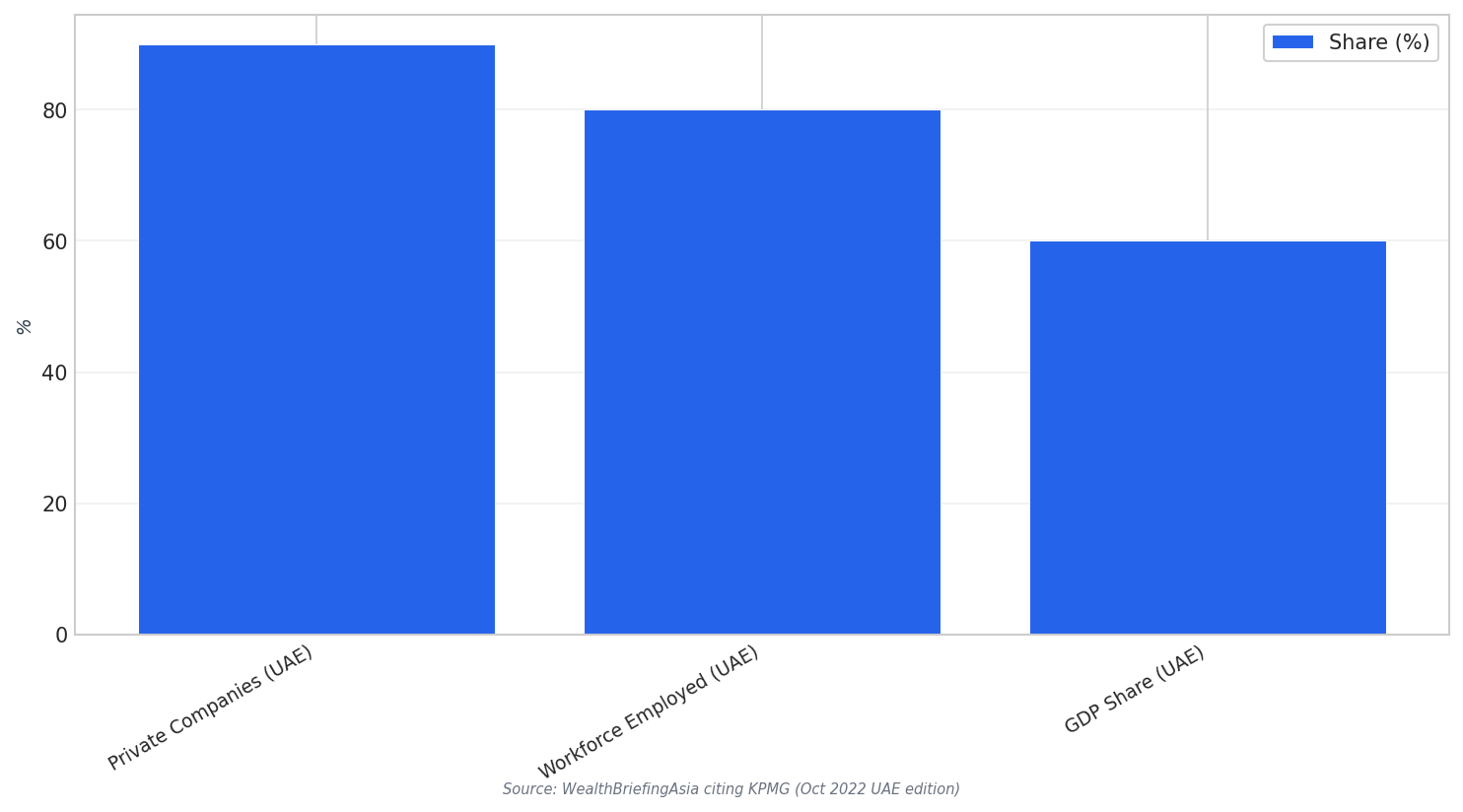
Governance is also increasingly linked to capital deployment and decision speed. Dubai Chambers discussions, quoted by Zawya, stress the need for more flexible and efficient models and redesigned governance frameworks to enhance the efficiency of decision-making. PwC data cited in the same Zawya report says the family business sector contributed AED 491.8 billion to Dubai’s GDP in 2024. In addition, PwC family office rankings for venture capital transactions show UAE family offices completed deals worth around AED 11 billion during the first six months of 2025, ranking third globally after the United States and the United Kingdom. While these figures are Dubai- and UAE-wide, they signal the scale and sophistication of family capital that Abu Dhabi groups operate alongside.
Succession, Ownership Transfers, and Civil-Law Clarity in Abu Dhabi
Succession is not only about leadership. It is also about ownership transfer mechanics and dispute avoidance. New amendments reviewed by the Ministry of Economy and Tourism regulate the disposal of shares or stakes belonging to a deceased partner or shareholder. They grant existing partners or shareholders, or the company itself, priority to purchase the shares at a value agreed with the heirs. If there is no agreement, the competent court determines the value through experts specialised in technical and financial aspects. The same amendments also aim to prevent administrative vacuums by regulating mechanisms for manager removal and resignation and ensuring the temporary continuation of the Board of Managers, supporting continuity when a transition is sudden.
For Abu Dhabi in particular, the legal environment around family matters has also become a factor in confidence and planning. The Financial Times highlights the Abu Dhabi Civil Family Court (ADCFC), established in 2021 as a secular venue catering to expatriates, and notes its popularity among wealthy people relocating to the UAE. Gulf News links rising prenuptial agreements to the UAE’s “modern and transparent family law system,” and explains that Abu Dhabi offers a civil system under Law No. 14 of 2021 on Civil Marriage and Divorce and Federal Decree-Law No. 41 of 2022 on Civil Personal Status. It adds that couples can register detailed prenuptial agreements directly with the ADCFC through a bilingual, user-friendly, efficient process. For family groups, these legal pathways can support clearer planning around assets, inheritances, and potential disputes.
The market impact of better rules and governance shows up in how families modernise and partner. WealthBriefingAsia notes that enhanced legal frameworks, including improved company and bankruptcy regulations and stronger investor protection measures, have increased investor confidence by providing greater transparency and accountability. The Fintech Times reports that, at a Dubai Family Office Summit, the ecosystem is managing over $1.2 trillion in assets and that the most pressing internal theme was the separation of legacy business from investment capital. The summit hosted over 250 attendees including 81 family offices, reinforcing the push toward sophisticated structuring. Taken together, UAE Family Business Law, governance upgrades, and clearer transition mechanics can help Abu Dhabi family groups protect value through succession and stay investable in a market that is professionalising quickly.
What problem is UAE Family Business Law trying to solve?
How do the Commercial Companies Law amendments affect inheritance of shares?
Why does governance matter for market performance and investment activity?
What Abu Dhabi legal features can support family wealth planning?
What does the region’s wealth transfer context imply for Abu Dhabi family groups?