

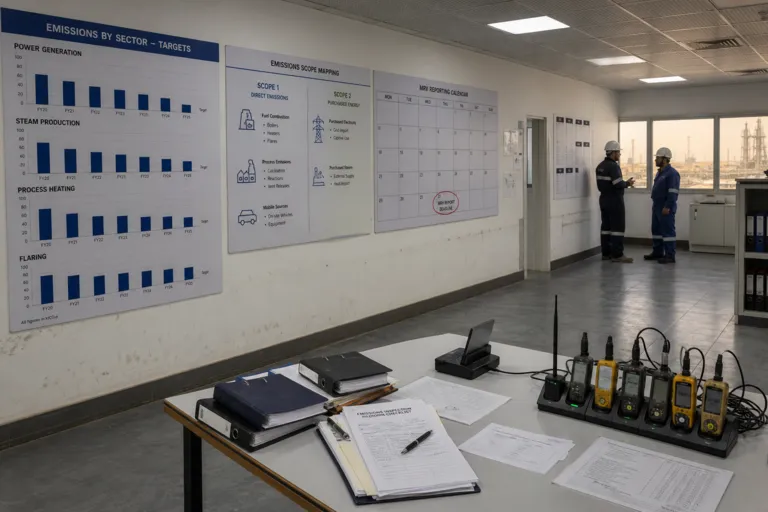
The UAE climate change law is now in force and sets legally binding duties to measure, report, and reduce greenhouse gas emissions. Federal Decree Law No. 11 of 2024 on the Reduction of the Effects of Climate Change was issued on 28 August 2024 and entered into force on 30 May 2025, with a compliance deadline of 30 May 2026. Multiple sources describe the scope as broad: it applies to all public and private entities in the UAE that generate GHG emissions, including free zones and state-owned enterprises, with no minimum size or turnover threshold and no sector exemptions. The core requirement is mandatory reporting of Scope 1 and Scope 2 emissions by 30 May 2026. Scope 3 reporting is anticipated to become mandatory from 2027.
For many companies, the biggest change is that voluntary sustainability or ESG reporting does not satisfy the legal requirement. Compliance is built around the national Measurement, Reporting and Verification process overseen by the Ministry of Climate Change and Environment (MOCCAE). Businesses must register on the national MRV platform and report through MOCCAE’s Integrated Emissions Quantification Tool (IEQT), which is accessible at mrv.ae. The process includes setting up an administrator account, assigning roles for data provision and validation, and submitting emissions data on an annual cycle. Entities with operations in Abu Dhabi should also note that a parallel process may apply through the Environment Agency Abu Dhabi’s Enhanced Transparency Framework MRV system, which links to the national platform.
New Reduction Planning and Sectoral Targets for 2026 Filings
Beyond reporting, the law requires organisations to plan and demonstrate emissions reductions. Sources describe a structured reduction plan as a required element of compliance, and annual filings are expected to include details of existing and planned reduction measures. Those measures are intended to align with sector-specific targets that are to be published by the UAE Cabinet. This is why 2026 is not only a reporting milestone, but also a practical start date for sectoral reduction expectations that influence what companies file and how they justify improvement over time. Businesses are also told to monitor MOCCAE guidance and sector-specific standards as they are published, because methodologies, standards, and implementation details are still evolving.
The regime includes additional obligations for “large emitters” under Cabinet Resolution No. 67 of 2024 concerning the National Register for Carbon Credits. That resolution applies to public and private sector entities with combined annual Scope 1 and 2 emissions within the UAE of at least 0.5 million metric tons of carbon dioxide equivalent (MT CO2e). One source notes that large emitters had until 28 June 2025 to comply with that resolution and may face extra requirements such as mandatory registration with the National Carbon Credit Registry and third-party verification in accordance with ISO 14064 and ISO 14065. Another source notes that Abu Dhabi’s MRV system will require independent third-party verification beginning in 2027 for the reporting year 2026, with the verifier meeting ISO accreditation requirements including ISO 14065.
Enforcement risk is real, and the fines cited across sources are significant. One source states that non-compliance can carry fines of up to AED 2,000,000, doubling to AED 4,000,000 for repeat violations within two years. Another source describes penalties for violations of emissions measurement, reporting, and recordkeeping requirements as a fine between AED 50,000 and AED 2,000,000 (approximately US$13,600 to US$545,000 as of April 2026). Alongside reporting and reduction planning, organisations should also be prepared for recordkeeping expectations, with one source noting records may need to be maintained for up to five years. Some commentary indicates MOCCAE representatives have suggested the 30 May 2026 deadline could be extended, pending a technical guidance document, but businesses are still advised to prepare against the stated deadline.
When do Scope 1 and Scope 2 emissions reports need to be filed in the UAE?
Who must comply with the UAE’s climate change reporting rules?
What platform is used to report emissions under MOCCAE?
How do “large emitters” differ under the UAE framework?
What penalties can apply under the UAE climate change law?