
In 2026, the Abu Dhabi retail media market sits inside a wider UAE and Middle East ad ecosystem that is scaling and digitizing. At the regional level, the Middle East advertising market was worth USD 8.44 billion in 2025 and is estimated to rise from USD 8.79 billion in 2026 to USD 12.19 billion by 2034, at a 4.17% CAGR (2026–2034). The same source points to performance-led demand tied to e-commerce expansion, naming platforms such as Noon and Amazon, ae.ae as part of the environment increasing appetite for measurable models. That backdrop matters for Abu Dhabi because retail media is built on first-party environments, and measurement has become a buying criterion rather than a nice-to-have.
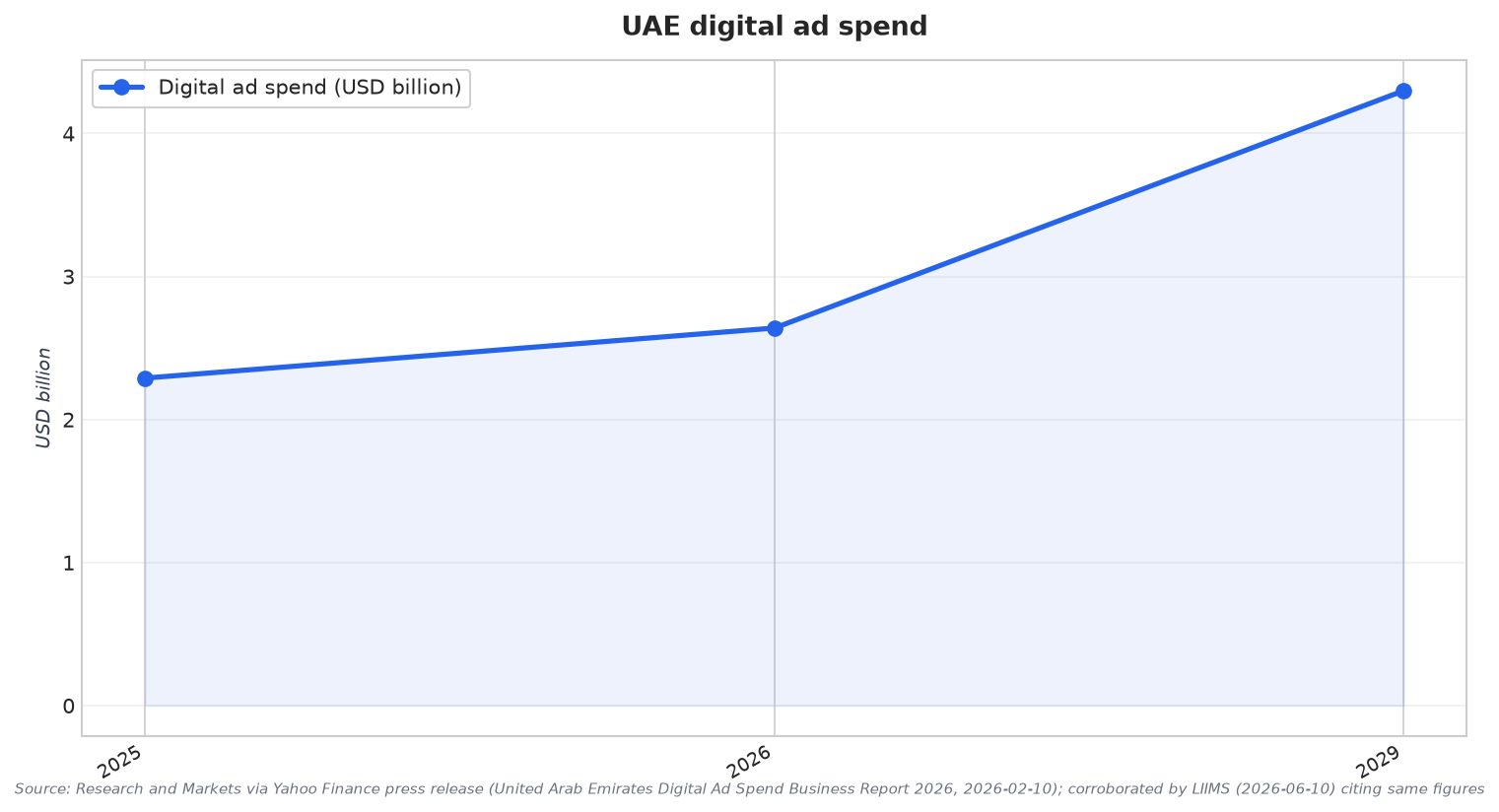
UAE digital budgets are still the clearest signal of where overall planning is heading. A UAE digital ad spend report expects the country’s digital ad spend market to grow by 15.2% annually to reach US$2.64 billion by 2026, up from US$2.29 billion in 2025. The same report projects the market to reach approximately US$4.30 billion by the end of 2029, with a forecast CAGR of 17.7% from 2026 to 2029. In parallel, the Middle East digital ad spend market is presented as expanding from its 2025 value of US$10.1 billion to approximately US$18.5 billion by 2029, with an expected CAGR of 16.9% from 2026 to 2029. For Abu Dhabi teams, this sets up a practical question: how much growth lands in retailer-owned placements versus open-web performance channels as retail media becomes a more formal “planning pillar” in the region.
OOH Goes Digital Faster, but Attribution Stays Uneven
Out-of-home is also changing shape, which affects how spend shifts get justified. In the United Arab Emirates, the DOOH market size was valued at USD 53.91 million in 2025 and is estimated to grow from USD 62.61 million in 2026 to USD 114.3 million by 2031 (12.79% CAGR, 2026–2031). Within that UAE total, roadside displays held 42.94% revenue share in 2025, and billboards represented 37.89% of market size; non-programmatic screens led with 59.87% of share. Retail was the top end-user industry at 27.06% of UAE DOOH spending in 2025, highlighting why retail media and DOOH are increasingly linked in planning. At the same time, programmatic DOOH formats are advancing at a 16.03% CAGR through 2031, which pushes Abu Dhabi buyers to ask for consistent impression logic, clear reporting, and cross-channel comparisons that many mixed networks still struggle to provide.
Retail media growth is being framed regionally as a response to advertiser demand for measurable, first-party-led environments and retailer interest in diversifying revenue streams. A Middle East digital ad spend report describes retail media becoming a mainstream planning pillar for categories such as electronics, FMCG, beauty, and lifestyle, supported by more sophisticated measurement and attribution inside retailer-owned environments. But the same regional context also signals why measurement remains difficult when brands try to unify reporting across retail media, social, and OOH. UAE and Saudi Arabia are cited as having updated rules requiring influencer licensing, clear labeling of paid content, and stricter compliance for targeted advertising, driving investment in consent management, brand-safety controls, and transparent reporting structures. For Abu Dhabi plans, that means measurement challenges are not only technical; they are also shaped by compliance-led shifts in how targeting and reporting can be executed.
What changes in 2026 is the pressure to connect store-adjacent media with real-world exposure at scale. Regional digital usage patterns encourage that push: the Arab Social Media Report (via the Middle East advertising market source) states the region recorded 190 million active social media users in 2023, with average daily usage reaching 3.5 hours. The same source says that in the UAE and Saudi Arabia, digital advertising accounted for 68% of total ad spend in 2023, with Instagram, Snapchat, and YouTube dominating engagement. Those numbers underline why retail media cannot be planned in isolation from broader digital behavior, and why DOOH owners are moving toward data-fueled screens and anonymized analytics. Still, Abu Dhabi marketers will likely face the same core gap: linking retailer-owned attribution and identity mapping to DOOH reach metrics in a way that is comparable, privacy-aligned, and stable enough for year-over-year budgeting.
What signals point to rising digital budgets in the UAE for 2026?
How fast is the UAE DOOH market projected to grow through 2031?
Why are retail media and DOOH being planned together for Abu Dhabi buyers?
What measurement challenges could shape the Abu Dhabi retail media market in 2026?
What broader Middle East ad-spend context matters for Abu Dhabi planning?