

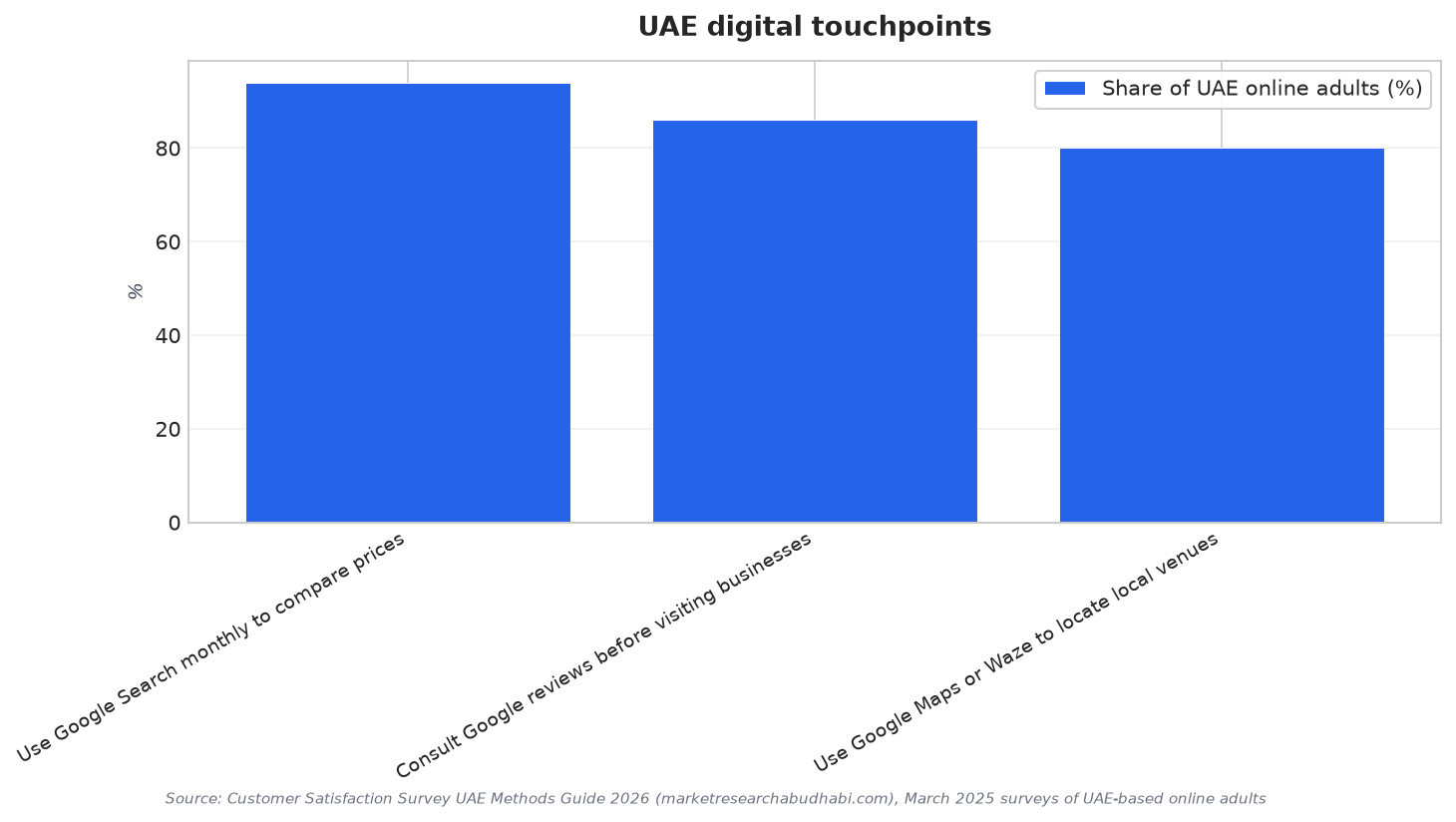
For Abu Dhabi brands, NPS benchmarking UAE programs should start with two realities. First, the same NPS number can mean different things in different sectors, so you need peer baselines before you label a score “good.” Second, in the UAE, the customer journey often begins before anyone enters a store, clinic, branch, or hotel. March 2025 surveys of UAE-based online adults found that 94% use Google Search monthly to compare prices, 86% consult Google reviews before visiting businesses, and 80% use Google Maps or Waze to locate local venues. That makes NPS sensitive to pricing clarity, review confidence, and location convenience, not only the core service moment.
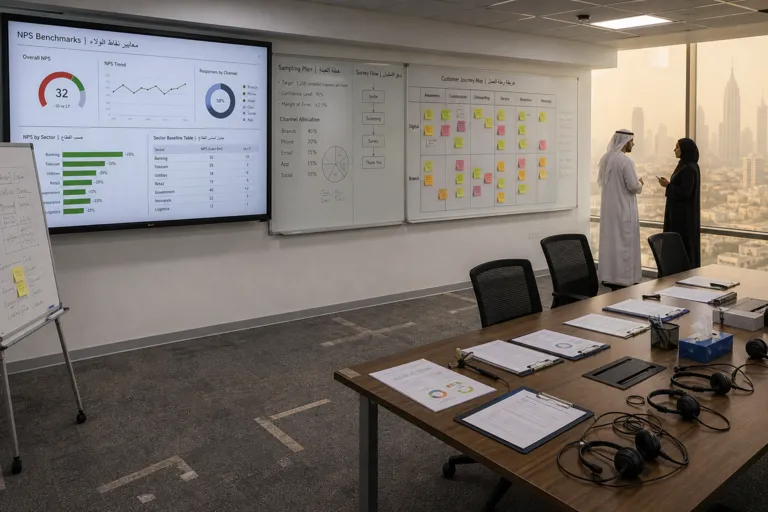
Benchmarking also requires consistent method so your score can be trusted over time. One UAE survey methodology reference point was conducted in March 2025 with 1,110 UAE-based online adults and 389 business leaders, carried out in English and Arabic, and weighted to ensure national representation. Your company survey may be smaller, but you can borrow the discipline: keep a stable cadence, collect in both languages, and segment or weight so results are not dominated by one customer group. For calculation context, NPS is derived by subtracting the percentage of detractors (0–6) from promoters (9–10), yielding a score from -100 to 100.
Sector Baselines: Use Global Ranges Carefully, Then Localize
When you cannot find public UAE-by-sector NPS scorecards, global baselines can still help you sanity-check expectations—so long as you label them as global context, not local fact. One 2026 cross-industry reference reports an average NPS of 38, with a wide spread where professional services and insurance lead at 68–71 while internet/cable providers sit at 2–8. Another global benchmark source states an average NPS of 32 across over 150,000 organizations, and notes the top 25% have an NPS of 72 or higher. Use these numbers as guardrails while you build your own Abu Dhabi sector baseline from consistently measured internal data and competitor experience signals.
To make the benchmark actionable for Abu Dhabi, tie NPS to the same “before the visit” levers UAE customers use. Add short items about price-comparison ease (linked to the 94% Search behavior), review trust (linked to the 86% who check reviews), and findability (linked to the 80% using Maps/Waze). This turns a single NPS number into a diagnostic system for marketing content, listings accuracy, and frontline execution. For sector context, experience pressure can move quickly in hospitality: one UAE-focused report cited Dubai hotel average daily rates at AED 775 and citywide occupancy at 80.7% in Q1 2026 context, while another later described UAE hotels having “occupancy in the 20s vs 80s last year” for Q2.
Finally, adopt closed-loop practices and operational proxies that show whether NPS is improving in ways that matter. A UAE example cited an e& UAE relationship-manager initiative that “improved NPS” and “reduced churn,” and an eRM pilot that expanded by 425%. The same source reported that its Dashboard 360 experience drove a 57% increase in engaged sessions and a 51% rise in session growth while reducing reliance on support teams. Globally, one 2026 benchmark synthesis notes top-quartile NPS companies grow at roughly 2x the rate of bottom-quartile peers, and that Promoters generate 2.6x the lifetime revenue of Detractors, while organizations that close the Detractor loop within 48 hours and segment NPS by customer value tier see faster improvement over 12-month windows. For Abu Dhabi brands, the best practice is simple: benchmark, diagnose, and then fix the drivers customers feel first.
How should Abu Dhabi brands approach NPS benchmarking in the UAE?
What are credible reference points for “good” NPS scores?
Which UAE digital behaviors can influence NPS before the visit?
What operational signals can complement NPS when local scorecards are limited?
What closed-loop follow-up timing is mentioned in the benchmarks?