

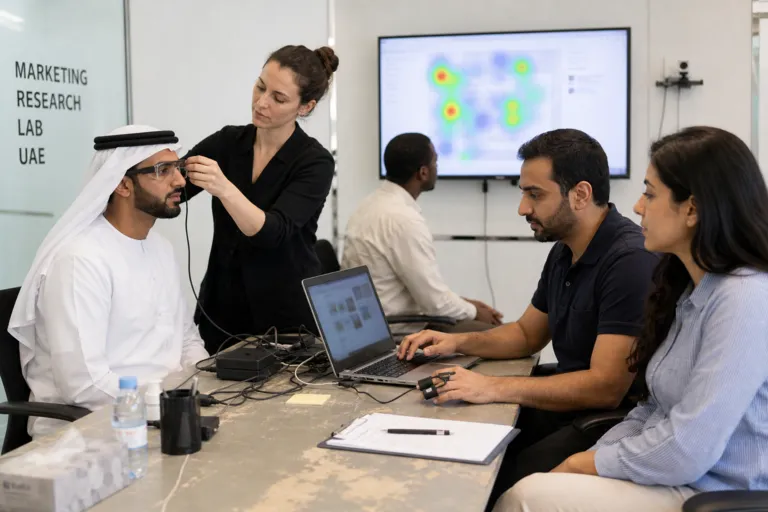
Neuromarketing is built on consumer neuroscience and physiological tracking. It looks at what people do and feel, not only what they say. Sources describe it as measuring brain activity, eye movements, and biometrics in response to marketing stimuli, instead of relying on self-reported opinions. That matters because surveys can miss subconscious decision-making triggers. At the same time, skepticism persists about predictive power and ethics, and the “jury is still out” on whether neuroscience can tell the ultimate truth about what a person is thinking. In practice, the value comes from using these tools to improve creative and placements, then validating with other methods.
For neuromarketing research UAE teams, eye-tracking is often the most direct upgrade over a questionnaire. Eye movement can show what interests a subject, what they understand, and how impacted they are by an experience. The method measures where subjects look, how much they blink, patterns of searching behavior, and pupil dilation. One source notes Coca-Cola uses eye tracking to monitor visual reception of packaging, product placement, and branded displays, to inform ad placement in retail environments and digital settings. That kind of output can answer questions a survey struggles with, like whether a key claim was actually seen, or whether attention moved in the intended order.
Biometrics and brain signals can add another layer when attention alone is not enough. Neuromarketing approaches can include EEG and other measures that capture responses in real time. The Drum reports Glassview’s partnership with Cogwear uses EEG headsets to capture emotion in real time, framing a future where campaign testing starts with brain data, not surveys. Another Drum piece highlights the importance of clarity, cognitive load, and emotional resonance in storyline testing. This is where a simple “like/dislike” answer can be too blunt. Biometrics can help detect whether the work is creating resonance or friction, while still leaving room for human interpretation.
Why It Matters Now in the UAE’s Fast-Shifting Digital Context
UAE marketing is operating inside a broader push toward digital and AI-powered growth. A Gulf Business report says Google contributed Dhs21.8bn to the UAE economy in 2024, and that Google’s Search and Ads products alone were responsible for Dhs20.2bn in economic activity in 2024. The same report notes more than 430,000 people in the UAE have received training in digital and AI skills since 2018 through Maharat Min Google. The methodology cited surveys in March 2025 with 1,110 UAE-based online adults and 389 business leaders. In this environment, measurement pressure rises. Brands want signals they can trust when budgets move quickly.
One reason neuromarketing techniques can outperform traditional surveys is that they can be paired with AI for planning and targeting without leaning on personal profiles. The Drum describes a shift toward optimizing for “receptivity,” and says neural responses even from a small group can predict how larger groups of audiences will react and behave. MediaPost reports Seedtag research that neuro-contextual ads deliver 3.5x higher neural engagement than non-contextual ads, with a 26% positive lift in responses, and 30% higher than standard IAB contextual ads. The same coverage links neuro-contextual alignment to a 26% increase in positive, approach-oriented emotions over standard contextual ads, and frames it as identifying moments when audiences are more open to engagement.
Still, surveys do not disappear, and ethics cannot be an afterthought. The Drum warns that neural data is “more internal,” and draws a consent-focused parallel to “Cambridge Analytica and Facebook” as examples of what happens when data is used without consent. Neuromarketing is strongest when it is used to diagnose attention, cognitive load, and emotional resonance, then compared with conventional feedback. It also fits a world where people feel “suspicious and tired of being tracked,” making relevance less about collecting more data and more about combining neuroscience and AI in ways that feel natural and meaningful.
What is neuromarketing research UAE teams can use instead of surveys?
How does eye-tracking add value over a traditional questionnaire?
What results have been reported for neuro-contextual advertising?
Why is receptivity discussed alongside neuroscience and AI?
What ethical issue must be addressed in neuromarketing studies?