
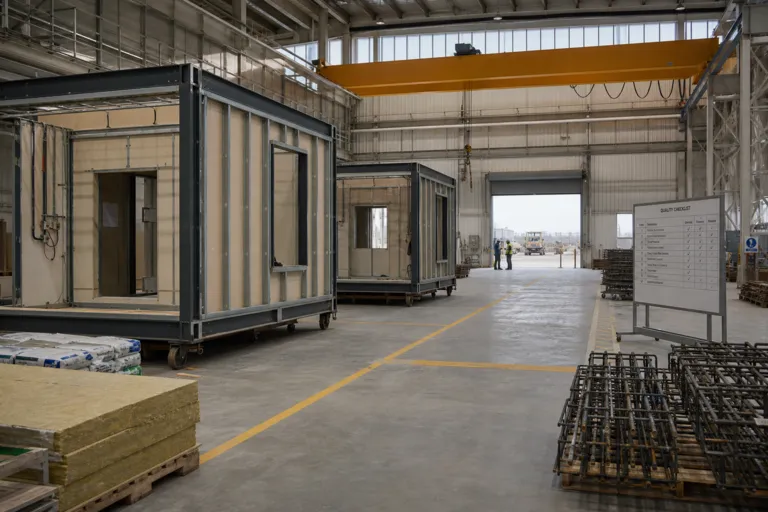
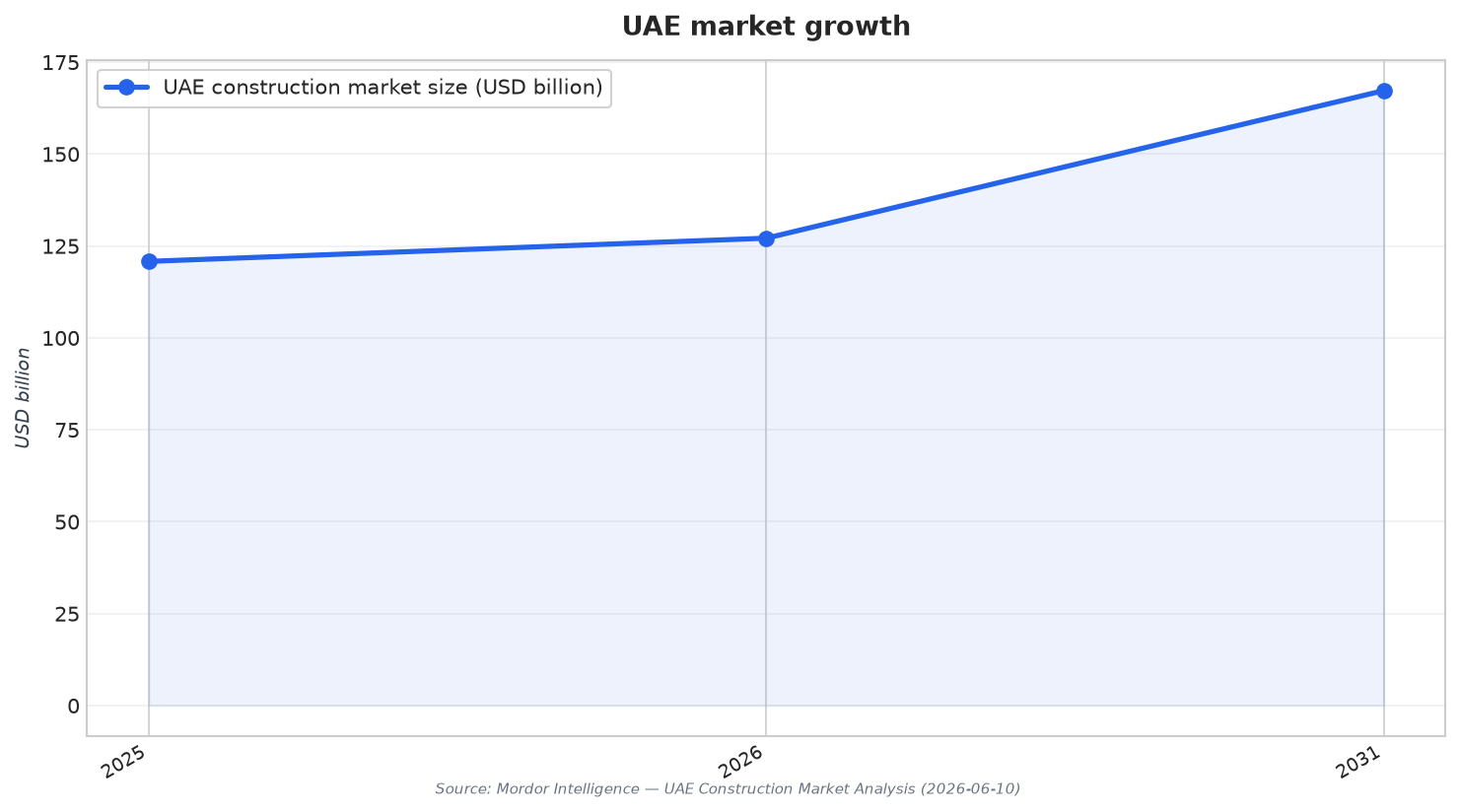
In 2026, modular and offsite delivery in Abu Dhabi sits inside a wider UAE construction upswing, but with sharper cost and schedule pressure. Mordor Intelligence projects the UAE construction market at USD 127.13 billion in 2026, up from USD 120.82 billion in 2025, and reaching USD 167.27 billion by 2031, with a 5.64% CAGR from 2026 to 2031. That scale matters for contractors because it coincides with “elevated material costs” and “tightening credit conditions,” which the same source links to a shift toward modular methods and integrated supply-chain strategies. For owners, the value case is less about novelty and more about protecting margins and improving schedule certainty.
Abu Dhabi’s pipeline signals why offsite capacity planning is becoming a board-level topic. GlobalData reports that in June 2026 the Abu Dhabi Projects and Infrastructure Centre (ADPIC) said it is overseeing more than AED200 billion ($54.5 billion) worth of capital projects across over 600 developments spanning housing, transport, healthcare, education, tourism, and community infrastructure. In parallel, an ADCCI analysis cited by IndexBox notes that by February 2026 Abu Dhabi had over 38,600 active construction permits. ADCCI also frames the sector’s next phase as being driven by “integration, quality, and dependability of delivery,” reinforced by rising uptake of modular and prefabricated building, AI-driven project oversight, and fully digital delivery approaches.
Cost and Speed in 2026: Why the Curve Is Bending Toward Offsite
Contractors tend to adopt modular when the math shifts from optional to necessary. At the UAE level, Mordor Intelligence reports that conventional on-site techniques still held 74.3% of 2025 value, while modular approaches are expanding at a 6.54% CAGR. That split suggests an adoption curve that is real but not yet dominant. Ken Research, via an openPR summary of its January 2026 analysis, values the United Arab Emirates modular construction market at USD 1.6 billion, and attributes expansion to faster project delivery, sustainability-focused regulations, and rising demand for cost-efficient assets across residential, commercial, hospitality, healthcare, education, and industrial infrastructure. The UAE-wide message is clear: speed is a demand signal, and cost control is the constraint that accelerates offsite decisions.
In Abu Dhabi, regulation and procurement expectations also shape how quickly contractors move from pilots to repeatable programs. MarkWide Research states that the Abu Dhabi Department of Municipalities and Transport requires minimum Pearl 2 ratings for new builds, and that embodied carbon limits are moving into procurement specifications. It also notes that Estidama Pearl Rating requirements are tightening. These requirements can compress timelines by adding certification checkpoints, which can favor standardized assemblies and coordinated delivery sequences. In this environment, the adoption curve often rewards firms that can integrate design, materials, and logistics, because fewer handoffs can reduce rework risk and improve predictability under tighter permit and compliance cycles.
Contractor adoption in 2026 is also influenced by macro volatility, which makes predictable delivery more valuable. GlobalData expects UAE construction growth to slow from 11.1% in real terms in 2025 to 4.8% in 2026 amid regional geopolitical tensions. It also reports that the Central Bank of the UAE lowered its 2026 GDP growth forecast to 1.6% in June 2026, and that average oil production fell to 2.68 million barrels per day in the first four months of 2026, an 8% YoY decrease. Yet public spending remains supportive: GlobalData says the UAE’s 2026 Budget set total expenditure at AED92.4 billion ($25.2 billion), up 29.2% from AED71.5 billion ($19.5 billion) in 2025, with 48% assigned to infrastructure and construction projects. For Abu Dhabi contractors, that mix can pull modular forward where schedule certainty and repeatable quality protect delivery performance across large, multi-project portfolios.
What is driving offsite and modular adoption in Abu Dhabi in 2026?
How large is the UAE modular construction market according to the provided sources?
What does the adoption curve look like for modular versus conventional methods in the UAE?
What project-pipeline signals matter most for Abu Dhabi contractors considering modular delivery?
How are Estidama requirements relevant to modular and offsite construction planning in Abu Dhabi?