
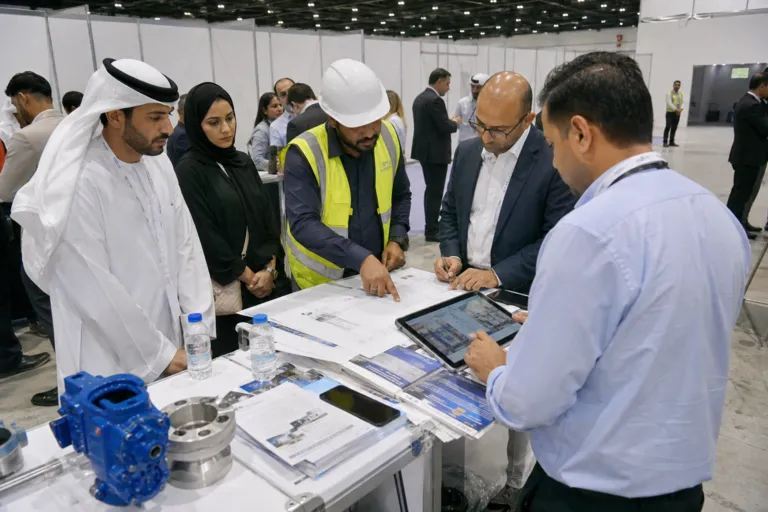
Make it in the Emirates 2026 is framed by ministers and officials as a push for industrial resilience built on strategic foresight, cutting-edge technology integration, and adaptable supply chains. The same conversations link growth to sustained advanced industry investments, strategic partnerships, and infrastructure development. For B2B suppliers, that translates into practical buying behavior: more localization efforts, more factory enablement, and more projects that reward dependable delivery and long-term support. The event’s positioning also aligns with the Net Zero by 2050 Strategic Initiative focus, where industry plays a role in lowering costs, improving operational efficiency, and reducing emissions through artificial intelligence, automation, and advanced technologies.
The most concrete pipeline indicator comes from the UAE’s project mix. Construction accounts for 62% of future pipeline projects, ahead of transport (12%), power (7%), and water (5%). Inside construction, mixed-use leads at 42%, followed by residential real estate (28%), data centres (9%), and hospitality (4%). For suppliers, this is a clear procurement map. Construction-heavy demand typically pulls through building materials, MEP, fit-out, structural fabrication, logistics, and project services. It also connects to “smart cities” and strategic infrastructure investment themes cited as drivers of robust growth and transformation in the UAE construction industry.
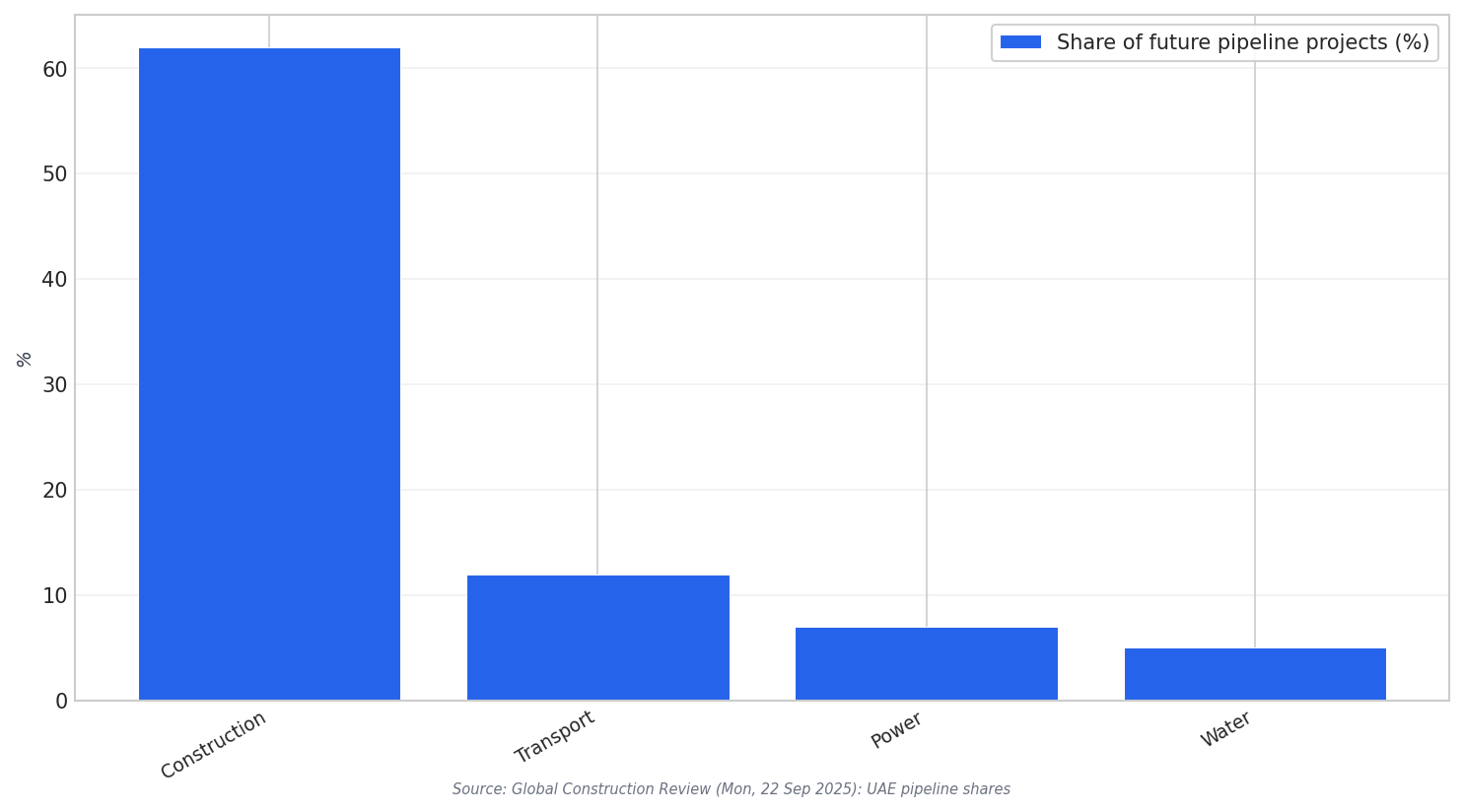
Industrial Deal Pipeline Breakdown: Where Supplier Budgets Cluster
On the manufacturing side, Abu Dhabi signals expansion capacity that can convert into supplier tenders. In 2025, the number of new industrial establishments moving to full operation increased by 53% to reach 115, compared to 75 in 2024. That growth is tied to the Abu Dhabi Industrial Strategy (ADIS) and its targeted programmes, including homegrown supply chains, ecosystem enablement, value chain development, Industry 4.0, circular economy, and talent development. For B2B suppliers, the near-term “deal pipeline” is less about one mega contract and more about repeatable factory needs: production equipment, automation, maintenance, industrial services, packaging, and compliance-related upgrades that come with new facilities reaching full operation.
Energy efficiency and resource intensity also point to sector-level winners. Abu Dhabi’s Energy Efficiency Accelerators in the Industrial Sector initiative focuses on construction materials, food and beverages, metals, paper industries, rubber and plastics, and chemical and pharmaceutical industries. It also quantifies why metals stand out: the metals sector alone accounts for more than 51% of electricity use and 26% of water use annually within the non-oil industrial landscape. That concentration suggests strong demand for efficiency retrofits, process optimization, metering, controls, and specialized industrial components. It also fits the Make it in the UAE 2026 narrative of incentives, enablers, investment opportunities, and financing solutions, paired with international partnerships to support scaling.
Finally, supplier opportunity is reinforced by operating ecosystems built for manufacturing scale. RAKEZ highlights licensing and visa facilitation, banking coordination, workforce assistance, B2B matchmaking, and industry-focused workshops to support manufacturers. It also points to active production and export examples across electrical systems, solar glass, buses, consumer goods, stainless-steel solutions, fabricated structures for events, protective gear, and construction materials. For B2B suppliers, the winners around Make it in the Emirates 2026 are those that can serve construction-led demand, enable new industrial establishments, and deliver measurable efficiency outcomes in power- and water-heavy sectors, while meeting localization and resilience expectations.
What does Make it in the Emirates 2026 signal for B2B suppliers?
Which sector dominates the UAE future project pipeline?
Within construction, which project types lead the pipeline?
What manufacturing expansion milestone in Abu Dhabi supports a supplier pipeline view?
Which industrial field stands out for electricity and water intensity in Abu Dhabi’s non-oil sectors?