
AI moderation in qualitative research means using artificial intelligence to conduct or assist sessions by asking questions, probing responses, and adapting the conversation based on participant answers. Fuel Cycle describes it as a way to run qualitative interviews at a scale and speed that human moderators alone cannot match, without sacrificing depth. Harvard Business Review adds that AI-powered interviewers can enable rich, adaptive conversations with thousands of participants quickly and inexpensively, capturing emotional nuance and candid responses, including on sensitive topics or among hard-to-reach groups. For UAE teams working on Abu Dhabi studies, this reframes “qual” from a small-sample constraint into something that can be integrated earlier and more often across decision cycles.
The market context also matters. One UAE-focused report states the UAE’s AI market was valued at USD 3.18 billion in 2023 and is forecast to reach USD 8.54 billion by 2030, implying a 43.9% CAGR from 2024 to 2030. The same source also cites a Statista projection of USD 949.80 million in 2024 for a narrower scope, with a 28.54% CAGR from 2024 to 2030, reaching USD 4.285 billion. MarketsandMarkets separately projects the UAE generative AI market rising from USD 383.4 million in 2025 to USD 5,411.3 million by 2030 at a 46.0% CAGR, and the UAE agentic AI market growing from USD 65.3 million in 2025 to USD 1,021.5 million by 2030 at a 48.1% CAGR. Together, these figures point to an environment where AI-enabled research workflows are easier to justify, fund, and operationalize.
Where AI-Assisted Qualitative Research Fits in Abu Dhabi Studies
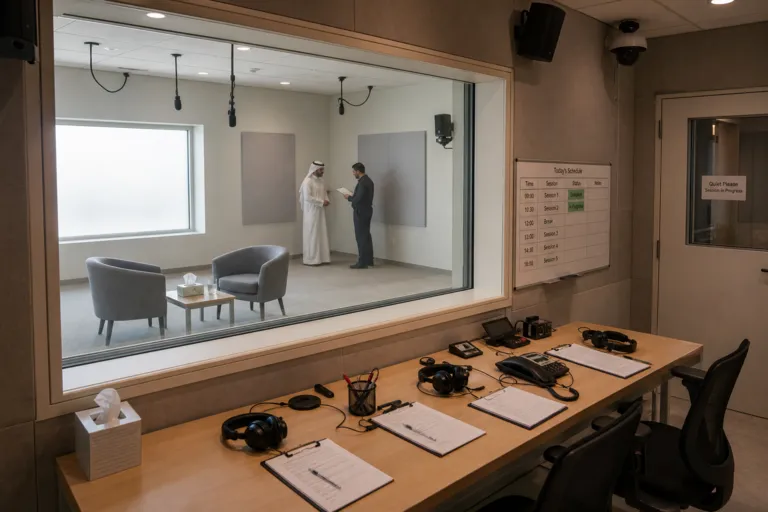
In practice, Abu Dhabi research programs already blend multiple qualitative formats. FieldworkHub describes online in-depth interviews (IDIs), in-person focus groups, and mixed-methodology work across the UAE, and defines IDIs as single-respondent sessions that can run face-to-face, online, or by phone. It also outlines digital formats like online bulletin boards (OBBs), where participants respond to a moderator at their own pace over a few days, and market research online communities (MROCs), which can stay active for weeks, months, or even years. AI moderation can fit beside these methods rather than replace them. For example, an AI interviewer can handle high-volume exploratory IDIs or concept checks, while human moderators can lead high-stakes stakeholder sessions, complex group dynamics, or culturally sensitive discussions where deep contextual interpretation is central.
A clear use case is scaling qualitative coverage across diverse Abu Dhabi populations. FieldworkHub references a project supporting a client in Abu Dhabi relating to health insurance for diabetics and patients with other common chronic conditions, recruiting Emirati patients, expat patients living in Abu Dhabi, and younger Emiratis for online interviews. In scenarios like this, AI-moderated workflows can help teams expand sample reach and standardize probing, because the system can adapt questions in real time based on participant answers. Fuel Cycle notes that AI-moderated qualitative research costs a fraction of equivalent human-moderated research at scale, making large-sample qualitative practical for more teams and more studies. When you need to compare subgroups consistently, this cost-and-scale profile can support more iterative learning without abandoning the qualitative “why.”
To implement AI-moderated interviews in UAE research responsibly, plan for a hybrid model and clear governance. Use AI sessions for rapid concept and message testing at scale, consumer-journey exploration, or early-stage hypothesis generation, and then validate with targeted human-moderated IDIs or focus groups. Keep the research environment unified where possible; Fuel Cycle points to a direction where qualitative interviews can run within the same environment teams use for surveys, panel management, and analysis. Position the approach as additive: AI delivers speed, consistency, and expanded coverage, while researchers provide study design, cultural interpretation, and final synthesis. This is the most practical way to deploy AI-moderated interviews UAE teams can defend in client readouts and internal decision-making.
What are AI-moderated interviews, and how do they work in qualitative research?
How can AI moderation support Abu Dhabi studies without replacing human moderators?
What UAE market signals suggest growing readiness for AI-enabled research approaches?
Which qualitative methods already commonly used in the UAE can pair well with AI moderation?