
The Abu Dhabi district cooling market in 2026 is best read through two lenses: UAE-wide growth expectations and Abu Dhabi’s operator-led buildout model. At a national level, one report values the UAE district cooling systems market at USD 3.70 billion in 2025 and projects USD 6.26 billion by 2033, at a 6.28% CAGR. Another UAE-focused guide similarly cites a market near USD 3.7 billion in 2025, projected to pass USD 6 billion by 2033. These projections are framed around high-density residential, commercial, hospitality, and mixed-use development patterns, where centralized chilled-water networks replace individual building chillers and aim to reduce peak electricity demand.
Demand growth in Abu Dhabi is also linked to new cooling loads that reward scalable infrastructure. Mordor Intelligence estimates the UAE data center cooling market size at USD 141.83 million in 2026, up from USD 120 million in 2025, with a projection of USD 327.09 million by 2031 (18.19% CAGR). The same source ties this to operational requirements such as ambient temperatures that often exceed 45 °C and targets below 1.2 for power-usage-effectiveness (PUE). It also describes policy pressure from the federal Climate Change Reduction Law effective May 2025, which it says increases scrutiny over greenhouse-gas emissions and prompts integration of district cooling tie-ins and renewable-powered free-cooling loops to support compliance and tariff incentives.
Operator Landscape in Abu Dhabi: Concessions, Capacity, and Regulation
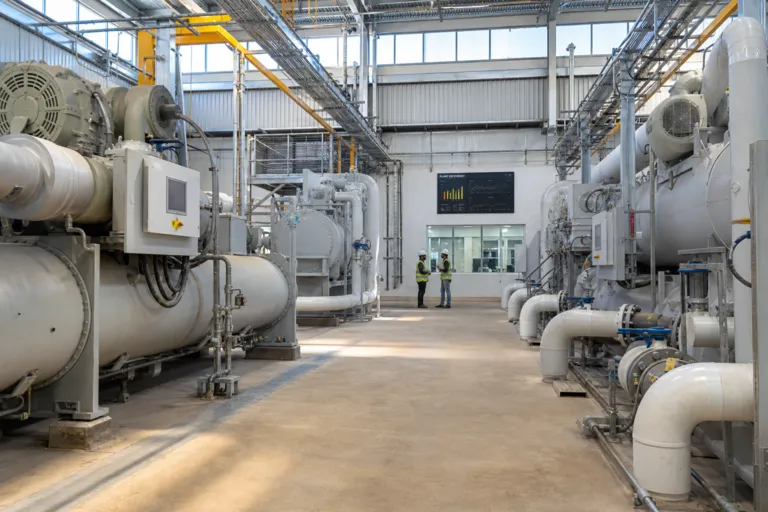
Abu Dhabi’s operator landscape in 2026 is shaped by long-term concessions and increasingly active infrastructure capital. Global Market Insights reports that in October 2025, Tabreed and global infrastructure investor CVC DIF completed the acquisition of PAL Cooling Holding from Multiply Group in a transaction valued at approximately USD 1.03 billion. The deal secures eight long-term district cooling concessions in Abu Dhabi—three on the mainland and five on Al Reem Island—covering five operational plants with a combined connected capacity of 182,000 RT as of December 2024. On the policy side, a UAE optimization guide notes that Abu Dhabi’s Department of Energy (DoE) licenses operators, regulates tariffs, and protects consumers, setting a compliance framework that influences project economics.
Efficiency investment drivers in 2026 are increasingly tied to technology choices that cut energy use and improve system performance at scale. Global Market Insights highlights that the “free cooling” segment is set to exceed USD 19 billion by 2035, describing adoption of systems that use ambient air or water sources to reduce energy consumption and improve seasonal efficiency. For Abu Dhabi, technology examples also include alternative energy inputs. A Business Research Company press release notes that in December 2023, Tabreed and ADNOC launched commercial operations for G2COOL, described as the Gulf region’s first geothermal-powered district cooling plant in Masdar City. The facility uses two geothermal wells delivering water above 90 degrees Celsius to absorption cooling units and supplies around 10% of Masdar City’s cooling demand.
For 2026 planning, Abu Dhabi’s district cooling decision-makers are balancing growth targets with optimization and consumer protections. A UAE guide states that district cooling meets under 20% of Dubai’s cooling demand today, while also citing a national ambition to reach around 40% of cooling from district cooling by 2030. The same source says the UAE Energy Strategy 2050 targets a 40% reduction in total energy demand, strengthening the case for plant and network optimization. In parallel, global market context varies by publisher: Global Market Insights estimates the district cooling market at USD 133.6 billion in 2025 and expects growth from USD 140.2 billion in 2026 to USD 200.2 billion by 2035 (4% CAGR), while Vertex projects a different global baseline and trajectory. These ranges provide context, but Abu Dhabi execution still depends on regulated tariffs, concession-backed investment, and proven efficiency upgrades.
What is driving demand growth in Abu Dhabi’s district cooling market in 2026?
What major operator move reshaped Abu Dhabi’s district cooling concessions recently?
Which regulator oversees licensing and tariffs for district cooling operators in Abu Dhabi?
What efficiency technologies are influencing district cooling investment decisions heading into 2026?
How much of Masdar City’s cooling demand is supplied by the G2COOL geothermal district cooling plant?