

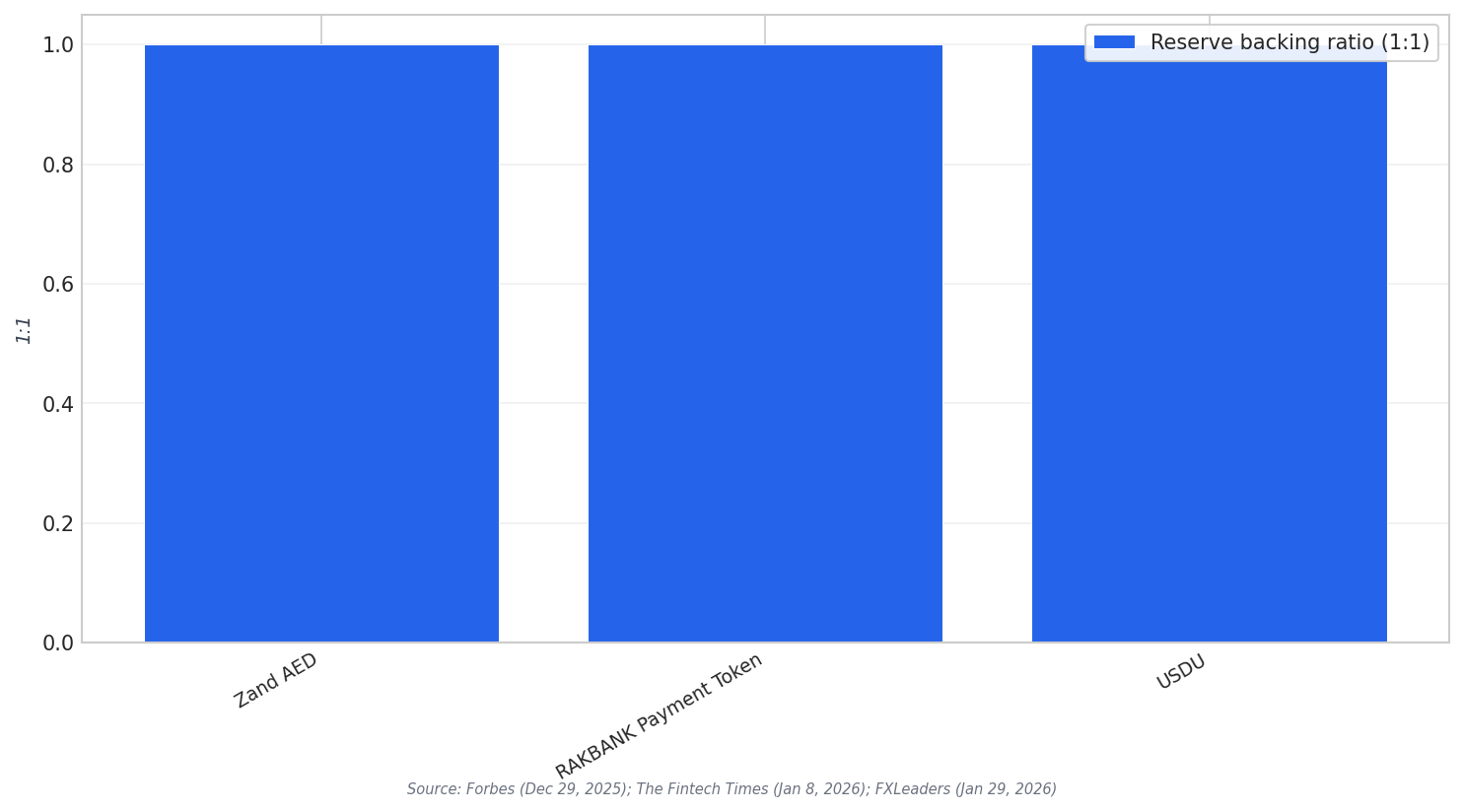
UAE stablecoin regulation is shifting stablecoins from a niche crypto tool into regulated financial plumbing. In 2025, major institutions moved in that direction. The Central Bank of the UAE (CBUAE) approved Zand Bank to issue Zand AED, described as the country’s first regulated, multichain AED-backed stablecoin on public blockchains. It is fully backed 1:1 and held in segregated AED accounts. In parallel, Circle, the issuer of USDC, secured a financial services permission from ADGM’s Financial Services Regulatory Authority (FSRA) to operate as a money services provider, embedding USDC further into the UAE’s regulated financial infrastructure.
The CBUAE’s role shows up repeatedly in payment-token approvals and infrastructure. RAKBANK (National Bank of Ras Al Khaimah) received in-principle approval from the CBUAE to issue an AED-backed payment token. RAKBANK said the token will be 1:1 AED backed, with funds held in segregated, regulated accounts, and it will use audited smart contracts with real-time reserve attestations. Separately, the UAE approved its first dollar-backed stablecoin, USDU, under the CBUAE’s Payment Token Services Regulation, with USDU pegged to the US dollar at a 1:1 ratio and supported by major local banks including Emirates NBD, Mashreq, and Mbank for reserves and banking operations.
VARA and ADGM FSRA: Issuance Rules, Licensing, and Enforcement
Dubai’s Virtual Assets Regulatory Authority (VARA) has pushed the market toward clearer issuance and disclosure expectations. VARA issued Guidance on the Virtual Assets Issuance Rulebook, described as a milestone that codifies how digital assets must be created, disclosed, and distributed within a fully licensed environment. A central pillar is disclosure-led regulation, with issuers explicitly required to provide comprehensive Whitepapers and Risk Disclosure Statements that are accurate, clear, and accessible. On the market-conduct side, enforcement has been visible too. A report cited that VARA issued 41 fines totaling over AED 48 million since the start of 2024, as virtual assets were described as being aggressively policed to sanitize the market.
Abu Dhabi’s ADGM FSRA is also tightening how stablecoins are treated inside its jurisdiction. After an initial framework issued in December 2024, the FSRA introduced final rule changes in October 2025 outlining how stablecoins will be treated within ADGM. The updated regime takes effect from 1 January 2026, broadens the range of regulated activities involving stablecoins, and aims to clarify evolving stablecoin-related business models. The framework is described as applying risk-based, proportionate requirements to authorized persons engaging in stablecoin-related activities, which reinforces the theme that stablecoins will operate under regulatory expectations similar to traditional financial instruments.
The regional “race” is not only about issuing tokens, but also about building regulated rails that users can trust across hubs. Rain’s VARA in-principle approval (IPA) was positioned as strategically critical because it completed the firm’s licensing footprint across the Gulf Cooperation Council. The firm was described as the only crypto-asset platform holding regulatory licenses and approvals from the Central Bank of Bahrain (CBB), ADGM FSRA, and VARA in Dubai, supporting a single platform experience across the region. Rain, founded in 2017, reported growing to over 2 million individuals and processing more than $11billion in total trading volume, while preparing to launch exchange and broker-dealer services in Dubai under the path from IPA to a full operational license.
What does “UAE stablecoin regulation” look like in practice?
Which regulated stablecoins were highlighted under UAE oversight?
What is VARA’s approach to virtual asset issuance?
How is ADGM FSRA changing stablecoin rules?
What enforcement signals show the UAE is policing the market?