
Building reliable qualitative insight starts with how you recruit. In the UAE, that challenge is amplified by a unique demographic mix. The country has a population of nearly 10 million people, and expatriates make up almost 90%, according to Cultural Traits. For brands running focus group research UAE projects, Abu Dhabi is not a single, uniform audience. It is a place where consumption patterns can differ by community, income level, and cultural tradition. It is also a highly digital environment, with internet penetration exceeding 99% (Cultural Traits), which changes how people discover brands, share opinions, and respond to research invitations.
Representative panels require more than “finding willing participants.” Buyers should ask where respondents are recruited from, whether UAE nationals and expat groups are represented properly, and whether the sample is balanced by emirate and income band, as BioBrain advises. That matters because the UAE does not behave like one identical market across emirates. Abu Dhabi, Dubai, Sharjah, and the Northern Emirates can differ, and research designs should reflect that local nuance (BioBrain). For additional context on population distribution, FMC Group notes that the three largest emirates—Abu Dhabi, Dubai, and Sharjah—are home to nearly 85% of the population, which helps explain why over-indexing recruitment in these areas can quickly bias “national” findings.
Recruiting for Abu Dhabi: Language, Culture, and Session Design
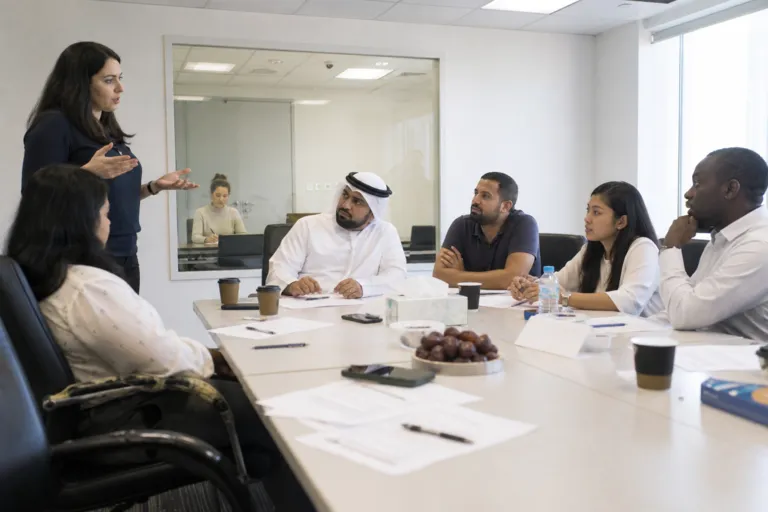
Abu Dhabi recruitment also has to plan for language switching and cultural sensitivity inside the room. Cultural Traits highlights that Arabic is the official language, but English is widely used, and large expatriate communities speak Hindi, Urdu, Tagalog, and Malayalam. In live discussions, participants may move between Arabic, English, and native languages, which can shift meaning and tone. Their approach includes bilingual moderators, simultaneous translators, and local researchers who capture non-verbal communication and cultural subtleties (Cultural Traits). This is not “nice to have” in a multicultural market; it is how you protect interpretation quality when religion, gender roles, and family influence how people express agreement, discomfort, or criticism.
What you do with those sessions should match what qualitative methods are best at explaining. BioBrain frames qualitative work as the pathway to understand motivations, trust barriers, cultural nuance, unmet needs, decision triggers, and emotional friction. Accurate ME similarly argues that qualitative research goes beyond statistics by surfacing the “why” behind choices, including unspoken norms and barriers that can distort decision-making if they are missed. In practice, this is why many primary studies in the UAE combine focus groups with in-depth interviews, fieldwork, and validation exercises, and why research may be conducted in English, Arabic, Hindi, Urdu, or other commonly used languages depending on the audience (Accurate Middle East).
Finally, a representative panel is only useful if the dataset is clean and the recruitment process is transparent. BioBrain recommends asking whether duplicates, speeders, bots, and weak responses are removed, and whether the provider clearly explains recruitment, screening, fieldwork, analysis, limitations, and quality controls. On the execution side, Think Positive describes focus group discussions as a qualitative method where a carefully selected group discusses a product, service, or concept, led by a trained moderator using open-ended questions. They also emphasize customized recruitment and selecting participants to represent the target audience, with factors such as age, sex, occupation, or lifestyle shaping who should be included. When these steps are combined, Abu Dhabi panels can reflect the market’s real mix rather than an easy-to-reach subset.
Why does representative recruitment matter for focus group research in the UAE?
Which emirates should researchers consider when sampling for Abu Dhabi insights?
How should language be handled in Abu Dhabi focus groups?
What quality checks should buyers ask about for UAE qualitative samples?