
Battery energy storage systems (BESS) are increasingly positioned as the “missing link” for renewables because they store electricity in rechargeable batteries and release it when needed. That function directly addresses intermittency, such as solar generation limited to daylight and wind output that depends on weather. The Abu Dhabi-based International Renewable Energy Agency has said that as power systems integrate variable renewable energy sources, the need for flexible and reliable grids that can supply electricity at all times has become essential. In practice, BESS is being used for renewable integration, peak shaving, load shifting, frequency regulation, grid stabilisation, backup power, and energy cost optimisation, according to analysts quoted by The National.
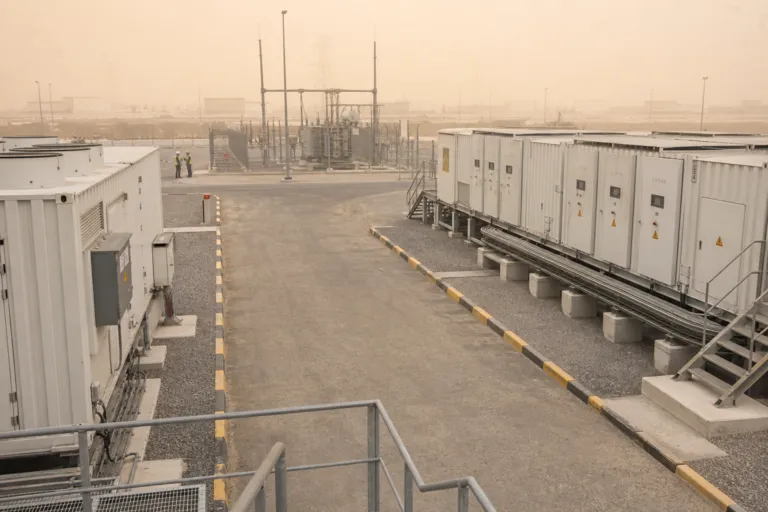
Within the Abu Dhabi battery energy storage market topic, the most visible grid-scale pipeline signal is the round-the-clock (RTC) renewables project tied to Abu Dhabi. Industrial Info Resources reports that Masdar and Emirates Water and Electricity Company (EWEC) selected BYD Energy Storage to supply a single Haohan BESS facility rated at 1,644 MW/11,275 GWh for the RTC project. The RTC project pairs a 5.2 GW solar power project with a 19 GWh BESS system designed to deal with renewable intermittency. Masdar said the RTC will be able to deliver 1 GW of continuous, baseload power “at a competitive cost.” Work started last October, and completion is expected in 2027.
What the Abu Dhabi RTC Project Signals for Grid-Scale Storage
The RTC project also illustrates how financing and supply chains are forming around very large batteries. Masdar confirmed final close, investing USD 1 billion, with the remaining USD 5.1 billion supplied by a consortium of 13 international and local banks. Industrial Info Resources adds that there are three key BESS projects in the UAE worth almost USD 6.3 billion in investment, with the RTC project accounting for more than USD 6 billion alone. On technology, BYD said the Haohan system uses its 2,710 Ah Blade Battery and is designed for desert conditions, with an IP66-rated enclosure and an operating temperature range of -30°C to 55°C. The same source notes Masdar contracted Sungrow to supply 7.5 GWh of PowerTitan 3.0 energy storage systems for the RTC project, alongside 2.6 GW of PV inverters for the solar project.
These projects sit inside a broader renewables-and-flexibility push. Mordor Intelligence states that the United Arab Emirates, Saudi Arabia, and Oman have collectively scheduled more than 120 GW of solar and wind for delivery by 2030, which obliges utilities to secure dispatchable storage for evening ramps. Separately, the UAE Energy Strategy 2050 calls for tripling renewable energy in the energy mix to achieve net-zero emissions by 2050 and targets 50% renewables in the energy mix, according to Industrial Info Resources. In regional market context, Grand View Research reports that the UAE held the largest revenue share of 34.85% in the Middle East BESS market in 2024, attributing momentum to renewable deployment and grid modernisation under the UAE Energy Strategy 2050, while noting storage pilots advanced by Dubai Electricity and Water Authority (DEWA) and the Abu Dhabi Energy Department.
Globally, the same dynamics help explain why grid-scale batteries are moving from niche reliability tools toward mainstream infrastructure. Mordor Intelligence estimates the Battery Energy Storage System market size is expected to grow from USD 76.69 billion in 2025 to USD 89.89 billion in 2026 and reach USD 198.88 billion by 2031, at a 17.21% CAGR over 2026–2031. In that report’s global segmentation, lithium-ion commanded 88.05% market share in 2025, and on-grid installations held a 77.35% share. The National also notes rising lithium-ion demand and cites the International Energy Agency’s finding that production increased sixfold between 2020 and 2025. For Abu Dhabi’s 2030 renewable integration opportunity, these global trends matter mainly as context: they underline why large, financeable, grid-connected BESS is increasingly central to delivering reliable clean power.
What is a BESS, and why does it matter for renewable power?
What are the key grid-scale BESS figures for Abu Dhabi’s RTC project?
How is the RTC project being financed?
What does the UAE’s regional position suggest about storage momentum?
What is the opportunity for the Abu Dhabi battery energy storage market toward 2030?