
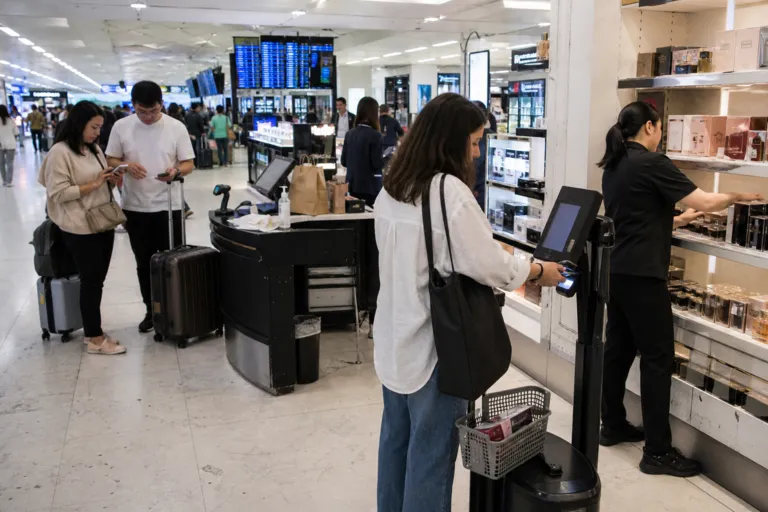
Airport retail and duty-free in Abu Dhabi sits inside a wider Middle East and Africa travel retail expansion cycle. One regional forecast projects the Middle East and Africa travel retail market growing from USD 8.24 billion in 2026 to USD 15.59 billion by 2031, at a 13.61% CAGR. The same outlook ties growth to airport-capacity increases, leisure travelers regaining confidence, e-commerce partnerships that lift basket values, and duty-free price advantages that can pull spending away from domestic retail. For concession planning in 2026, these drivers matter because they translate into more footfall, higher conversion potential, and more willingness to transact digitally at the airport.
Global benchmarks also support a constructive 2026 story, while requiring careful local interpretation. One global duty-free and travel retail forecast expects the market to expand from USD 48,902.11 million in 2026 to USD 53,386.43 million in 2027, reaching USD 107,710.34 million by 2035 at a 9.17% CAGR. In 2024, the same source says over 1.6 billion international travelers made purchases through duty-free outlets, representing 27% of all global travel retail sales transactions. It also reports airport retail as the dominant channel, accounting for 68% of total global market activity. For Abu Dhabi, these figures do not quantify local sales, but they show why airports remain the main concession battleground heading into 2026.
What 2026 Concessions Should Optimize For
Category strategy can be anchored in published mix data, then adapted to the passenger profile. In the Middle East and Africa, fragrances and cosmetics held 31.74% share in 2025. A separate global breakdown puts personal care and cosmetics at 32% share, while liquor and tobacco combined make up 41%. Another global report lists perfumes and cosmetics at 35.74% share in 2025 and notes premium and luxury at 49.36% share. Together, these inputs suggest that beauty-led assortments and premium positioning can be central to the Abu Dhabi airport retail market in 2026, especially when supported by gifting-friendly bundles, clear value signage, and strong availability for high-velocity SKUs.
Digital enablement is no longer optional in concession tenders, because multiple sources point to measurable benefits. A regional outlook highlights rapid adoption of mobile wallets and the rollout of click-and-collect and frictionless payment systems in expanding airport retail footprints. Globally, around 54% of new duty-free stores integrate omnichannel strategies with digital payments and pre-order platforms, and this is associated with a 47% improvement in transaction efficiency. Another forecast says e-commerce and omnichannel pre-order are projected to grow at a 12.74% CAGR through 2031. For Abu Dhabi in 2026, concession value can be defended by using pre-order to secure spend earlier, then using fast pickup to protect conversion during peak flows.
Passenger growth signals across the GCC add context for Abu Dhabi’s opportunity, even when the largest capacity figures come from neighboring hubs. One regional report cites major investments such as Saudi Arabia committing USD 30 billion to enhance King Salman International Airport by 120 million passengers, and Dubai investing USD 34.85 billion to expand Al Maktoum International, alongside a stated ambition for 330 million passengers by 2030. Within the UAE, a market overview describes airport retail as the dominant channel and says Dubai’s airports are expanding retail spaces, with over 400 retail outlets projected in future and an estimated 80 million passengers passing through Dubai Airport in future. These data points are not Abu Dhabi-specific, but they reinforce why 2026 concession design in Abu Dhabi should assume competitive, high-throughput retail standards across the region.
What is the 2026 regional growth outlook that matters most for Abu Dhabi airport retail?
Which categories should lead a 2026 duty-free concession mix?
How important is omnichannel for airport duty-free in 2026?
How does the Abu Dhabi airport retail market compare with wider airport retail dominance globally?