
Abu Dhabi’s business formation momentum was clear in the first quarter of 2026. New economic licences across the emirate increased 21% year on year, while the number of active licences grew 12%, based on figures cited from the Abu Dhabi Registration and Licensing Authority. For market entrants, these are not abstract indicators. They show more businesses are being created, more are staying active, and the pipeline of new activity is broadening beyond a single niche. The same period also recorded stronger commercial activity signals, including advertisements increasing 26% and promotional campaigns rising 2%, reinforcing the picture of a market where companies are actively competing for attention.
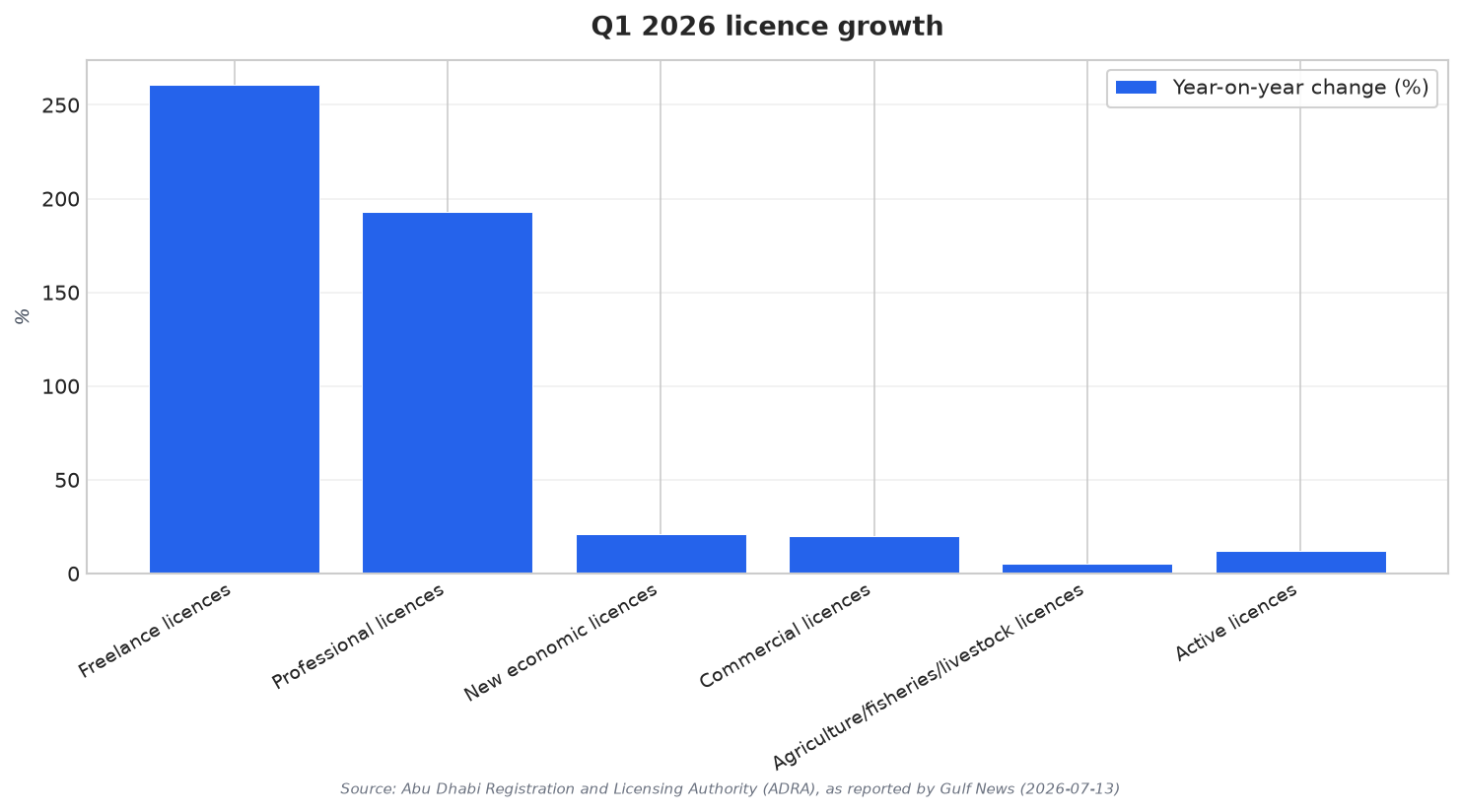
The category breakdown helps explain where demand is clustering. Freelance licences rose 261% in Q1 2026 compared with the same period a year earlier. Professional licences increased 193% year on year, and commercial licences grew 20%. Licences tied to agriculture, fisheries, and livestock activities increased 5%. The message for new entrants is that growth is not limited to one business type. Instead, Abu Dhabi is seeing simultaneous expansion in independent work, professional services, mainstream commercial activity, and selected primary-sector permits, suggesting multiple entry points depending on the business model and the regulatory category that best fits the activity.
What the Regional Split Reveals About Demand Hotspots
The rise in new licences was not confined to the capital’s core districts. Al Ain recorded the highest increase in new economic licences at 58% in Q1 2026. Al Dhafra followed with growth of 28%, while Abu Dhabi City posted an 18% increase. For companies assessing Abu Dhabi economic licences 2026 patterns, the regional split signals that the growth story has multiple centers. It also points to a deliberate widening of economic activity, with growth aligning to areas described as developing agriculture, logistics, manufacturing, tourism, and local service industries. Location strategy, therefore, can be a competitive decision, not just an administrative one.
Flexible formats are gaining traction, which matters for first-time founders and lean expansions. Abu Dhabi Trader licences increased 17%, and Mobdea licences for creative activities rose 15%. Alongside the 261% jump in freelance licences, these figures show that entry routes designed for smaller teams and early-stage operations are being used at growing scale. Several reports link this to expanded digital licensing services and streamlined company formation procedures intended to reduce time and administrative requirements. For entrants, the practical implication is that speed-to-launch and lower operational rigidity appear to be increasingly compatible with formal licensing pathways.
Industrial indicators add another layer for businesses watching supply chains and local production. In Q1 2026, industrial licences transitioning into the production phase increased by 3%, and 34 industrial facilities entered production during the quarter. Coverage connects these additions to strengthening domestic supply chains and expanding local manufacturing capacity under the Abu Dhabi Industrial Strategy, which aims to attract high-value investments, strengthen local manufacturing, and raise the industrial sector’s contribution to non-oil economic activity. For market entrants, the combined licensing and production signals suggest an ecosystem that is expanding both in services-led formation and in operational industrial capacity.
What happened to new economic licence issuance in Abu Dhabi in Q1 2026?
Which licence categories saw the fastest growth in Q1 2026?
Which Abu Dhabi regions led the increase in new licences during the quarter?
What do Abu Dhabi’s economic licence trends in 2026 suggest for new market entrants?