
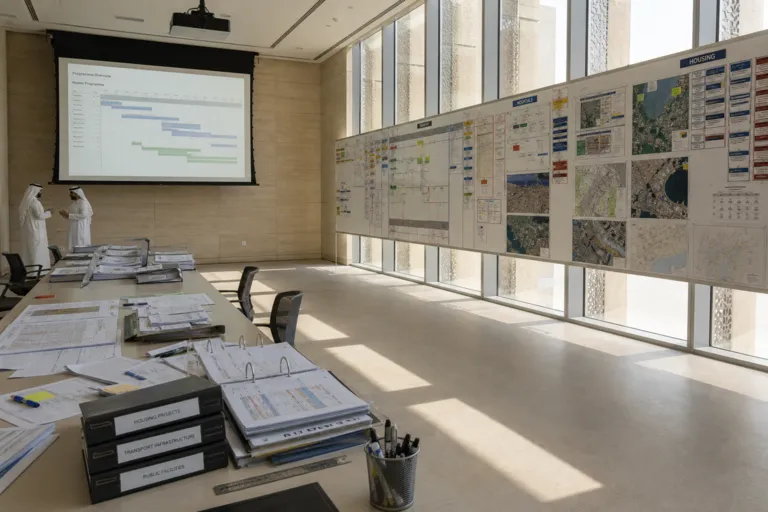
Abu Dhabi is advancing a large government-led development pipeline managed by the Abu Dhabi Projects and Infrastructure Centre (ADPIC). Gulf News and Dubai Standard report a capital investment portfolio worth more than Dh200 billion ($54.5 billion). The portfolio spans over 600 ongoing projects across housing, transportation, healthcare, education, tourism, and community infrastructure. The stated direction is long-term: diversify beyond oil, improve residents’ quality of life, and position the emirate as a global hub for business, tourism, and innovation. For companies assessing where near-term tenders may emerge, the breadth of sectors matters as much as the headline value.
The program’s mix includes new residential communities, road and transport networks, and hospitals and other public amenities, as highlighted across multiple summaries tied to the Forbes Middle East Building the Future Summit 2026. One breakdown published after the summit also lists stormwater drainage systems and water reservoirs, alongside schools, universities, cultural attractions, and sports facilities. In transport specifically, the same recap points to road networks spanning over 300 kilometers of new construction, plus bridges, tunnels, and major interchanges connecting development zones. These details signal that procurement is not limited to a single asset type, and that packages can range from civils to social infrastructure.
Private Bidders: A Dh55 Billion PPP Pipeline for 2026-2027
For private bidders, the most direct opening is a public-private partnership pipeline. A post-summit report describes a Dh55 billion public-private partnership program covering 24 new projects scheduled for 2026 and 2027. That same source frames the projects as funded, planned, and phased initiatives managed by ADPIC. It also notes an integrated governance framework with 14 government entities working together to speed execution and improve coordination. For firms tracking the Abu Dhabi infrastructure plan 2026, this PPP channel is the clearest signpost for how capital can be deployed with private participation across housing, roads, and health-related facilities.
The pipeline was spotlighted during the Forbes Middle East Building the Future Summit 2026, a two-day event held June 23-24 in Abu Dhabi under the patronage of the UAE Ministry of Energy and Infrastructure. Reports say the summit brought together about 3,000 policymakers, business executives, and industry experts. The agenda focused on the intersection of infrastructure, smart cities, clean energy, mobility, and artificial intelligence, including project financing and the integration of digital technologies into urban planning. This matters for bidders because it signals procurement conversations are increasingly tied to delivery models, technology integration, and resilience outcomes.
Separate industry reporting adds broader UAE context that reinforces why contractors and suppliers are watching Abu Dhabi closely. A GlobeNewswire market report cites major opportunities including Abu Dhabi’s AED 55 billion ($15 billion) public-private partnership pipeline, matching the same PPP scale referenced in the summit recap. Another Research and Markets summary states that an Abu Dhabi government AED 240 billion ($65.4 billion) investment plan, announced in December 2025, is set to stimulate growth in housing, transportation, healthcare, and education over the next seven to ten years. Together, these signals point to sustained demand for delivery capacity across multiple public asset classes.
Who is overseeing Abu Dhabi’s major infrastructure project pipeline?
How many projects are in the current Abu Dhabi development portfolio?
What is the size and timing of the PPP program open to private participation?
What transport scope has been described within the project pipeline?
What does the Abu Dhabi infrastructure plan for 2026 emphasize for bidders?