

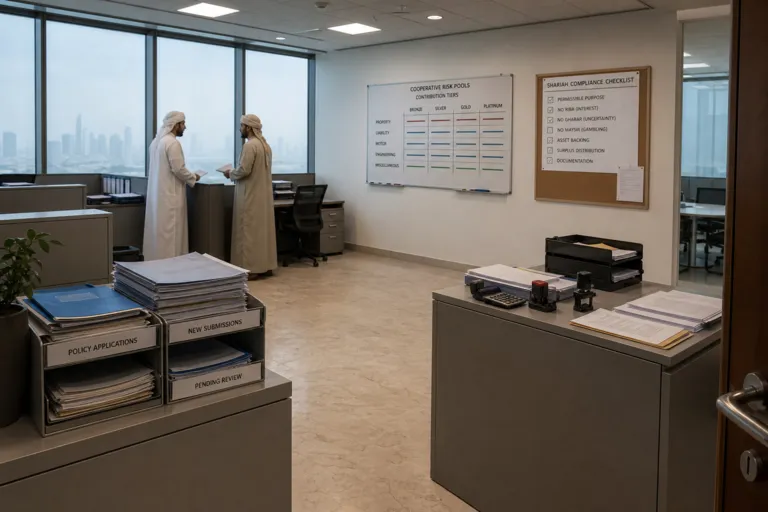
Takaful insurance is framed in the sources as a distinctive segment of Islamic financial services that follows Shariah principles. It is described as avoiding interest (riba), uncertainty (gharar), and investment in haram sectors, while operating through a cooperative risk-sharing model where participants contribute to a pooled fund for mutual protection. This positioning matters when discussing the Abu Dhabi takaful insurance market, because the “why” behind demand is inseparable from product structure: social solidarity, ethical investment, and collective responsibility are part of the value proposition. The sources also tie market momentum to rising awareness of Shariah-compliant financial products and a broader preference for ethical, community-oriented protection models.
While Abu Dhabi-specific market sizing is not provided in the cited material, the sources give global context that helps explain why local interest can be resilient going into 2026. Verified Market Reports values the global Takaful insurance market at USD 39.6 billion in 2025 and estimates it will reach USD 78.3 billion by 2034, with a CAGR of 7.87% from 2026 to 2034. A separate 2026 press release from The Business Research Company states the takaful market will grow from $36.5 billion in 2025 to $40.9 billion in 2026 at a CAGR of 12.0%. These figures describe the global market, not Abu Dhabi, but they reinforce a consistent theme: Shariah-compliant cover is expanding fast enough that provider strategies and customer education remain central topics for 2026 planning.
Provider Landscape in Abu Dhabi and the Wider UAE Context
The sources identify several operators connected to the UAE and Abu Dhabi when outlining “key players” globally. The Business Research Company list includes Abu Dhabi National Takaful, and HTF MI’s referenced study excerpt also names Abu Dhabi Islamic Insurance. Market Research Future similarly cites Abu Dhabi National Takaful Co. (AE), Salama Islamic Arab Insurance (AE), and Takaful Emarat (AE) among key players in its competitive landscape discussion. These lists do not quantify Abu Dhabi market share, but they do signal that Abu Dhabi-linked brands are recognized in multi-country coverage of the sector. For buyers, this suggests a provider environment shaped by both local operators and cross-border competitive benchmarking, especially as players position through innovation and regional expansion.
Several drivers for 2026 can be inferred directly from the sources’ stated growth factors, without assuming any Abu Dhabi-only metrics. Verified Market Reports points to supportive policies and licensing frameworks in key markets such as the GCC, alongside the proliferation of Islamic banking and finance institutions that seek to offer comprehensive Shariah-compliant services. The same source highlights digital platforms and InsurTech innovations as mechanisms that lower distribution costs, improve customer engagement, and enhance underwriting accuracy, expanding reach into underserved segments. Meanwhile, MarkWide Research emphasizes expanding Muslim population, rising awareness of Islamic financial products, and a growing preference for Shariah-compliant services as growth drivers. Together, these themes suggest that in 2026 the strongest pull factors are likely to combine regulation, Islamic finance ecosystem growth, and digitized distribution rather than any single product line alone.
Regional share figures in the sources also provide context for how the Middle East frames the competitive narrative, but they should not be read as Abu Dhabi-only facts. Market Research Future’s 2025 report states that the Middle East is the largest market at 60% share, with Europe at about 10%. In another Market Research Future report, the European market is described as holding about 5% of global Takaful share, with the UK at approximately 3% and Germany around 1%, and it notes that regulatory bodies are actively promoting Shariah-compliant financial products. For Abu Dhabi stakeholders, these numbers mainly function as a reminder that the Middle East is portrayed as the biggest regional arena in this sector, so differentiation in product sophistication, distribution efficiency, and trust-building education may be the practical levers to watch as 2026 unfolds.
What makes takaful insurance Shariah-compliant?
Which providers are cited in connection with Abu Dhabi or the UAE takaful landscape?
How fast is the global takaful market expected to grow in 2026 and beyond?
What are the main 2026 growth drivers relevant to the Abu Dhabi takaful insurance market discussion?