


Abu Dhabi Gen Z consumer behavior in 2026 reflects a careful mix of saving in some baskets and paying more in others. A First Insight study reported that a majority of Gen Z consumers (59%) are cutting staples like food and beverages and household goods to splurge in health and wellness and skincare and beauty. In the same study, 31% said they are most likely to purchase private label or store brand food and beverages to save money, and 24% said the same for household goods. Value is not only about price. USA TODAY, citing a Lightning Commerce study, reported that 62% of consumers said it was important that purchases align with personal values or identity, while price (78%) and quality (67%) remained key priorities.
That trade-off shows up in how Gen Z evaluates categories. First Insight found that in household goods and food and beverage, price is the primary motivator for purchase (30% and 33%), followed by quality (29% and 30%). But quality becomes the top factor for skincare and beauty (33%) and health and wellness (35%). At the same time, Gen Z can show brand flexibility. Chain Store Age noted Gen Z respondents were significantly less driven by prestige and name recognition of national brands when asked which brand “stands out first,” compared with older cohorts. Yet CSP Daily News reported that Gen Z consumers prefer national brands across consumer packaged goods categories, describing the pattern as a shift in spending across categories rather than outright rejection of established brands.
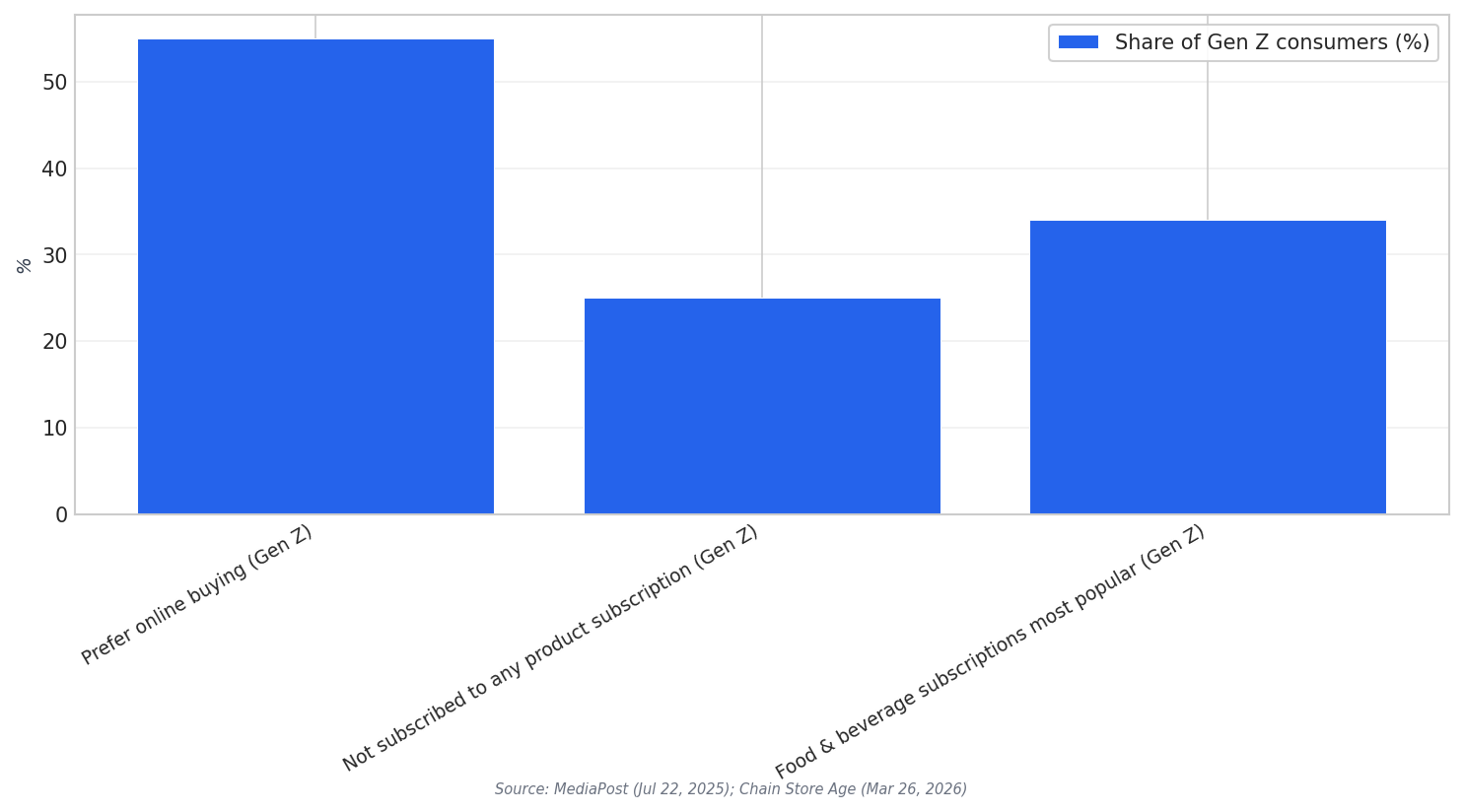
Shopping channels and routines also matter. MediaPost reported that 55% of Gen Z prefer online buying, compared with 45% of millennials, 31% of Gen X and 17% of baby boomers. But Gen Z does not engage the same way across all digital tools. The same MediaPost report said only 17% engage via email, versus 40% of older generations. Subscriptions are also common. Chain Store Age reported that only 25% of Gen Z say they are not subscribed to any product-based subscription services, and that food and beverage subscriptions are the most popular for Gen Z at 34%.
Media, Values, and the Brands Gen Z Will Reward
Media habits are fluid, and that has implications for how brands show up. Ad Age described Gen Z as consuming media across short-form video feeds, video games, creators and celebrities, and co-watching live events and movies with friends. But values still gatekeep attention and spending. Retail TouchPoints quoted that 94% of Gen Z report friction when trying to shop by their values, and many turn to thrift stores or circular models to bridge the gap. USA TODAY reported that in the past six months, Gen Z shoppers made buying decisions to support or avoid brands based on sustainability or environmental impact (37%), localism or national pride (29%), and religious or cultural alignment (26%). It also found that nearly one in three Gen Z respondents (32%) feared being judged for buying from the “wrong” brands.
Brand preference is also shaped by purpose and community signals, especially when the brand is smaller or local. MediaPost reported Gen Z’s key values as being a purpose-driven brand (57%), supporting local community issues (42%), and being environmentally conscious (39%). For entertainment and experiences, Gen Z can pay extra for sustainability and efficiency. Billboard reported Gen Z are willing to spend a premium of 26% or more on sustainable features for entertainment experiences, and that 24% of Gen Z would pay more for entertainment options that use renewable energy sources, while 22% would pay a premium for lower energy consumption. For Abu Dhabi marketers, the practical takeaway is to compete on clear value in staples, on quality in wellness and beauty, and on visible, credible values across channels where Gen Z actually engages.
What defines Abu Dhabi Gen Z consumer behavior in 2026?
Do Gen Z shoppers trade down on everyday items?
How does Gen Z prefer to buy: online or in-store?
How common are subscriptions among Gen Z?
Which values influence Gen Z brand choices most?