
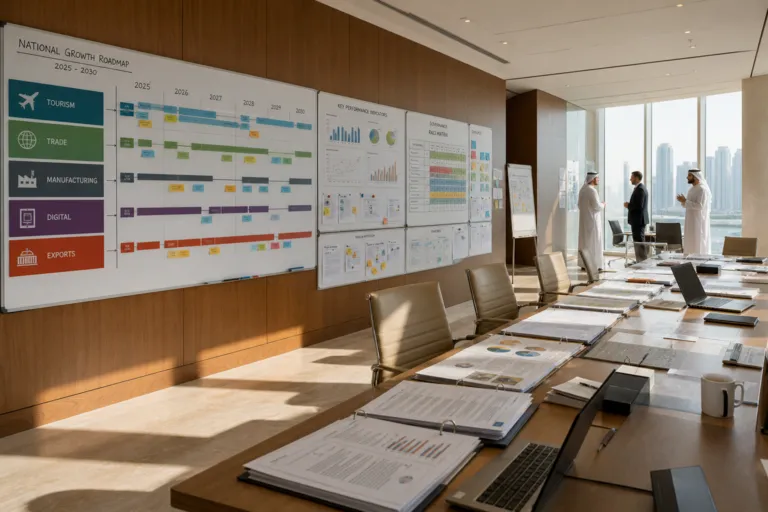
The federal roadmap is a 10-year national plan that guides development with social, economic, investment, and broader development priorities. Officially, it is designed to strengthen the UAE’s position as a global partner and an attractive, influential economic hub, while highlighting the country’s economic model and its opportunities for global partners. The framework is organised around four pillars that cover society, the economy, diplomacy, and the ecosystem. It also sets headline national indicators. By 2031, it aims to double GDP from AED 1.49 trillion to AED 3 trillion, generate AED 800 billion in non-oil exports, raise tourism’s contribution to GDP to AED 450 billion, and raise the value of foreign trade to AED 4 trillion.
Non-oil performance provides the operating context for diversification-focused sectors. Federal Competitiveness and Statistics Centre figures cited in 2024 analyses put non-oil sectors at about 75.5% of output. More recent FCSC data reported that the contribution of non-oil activities increased to 79.4% in Q1 2026, compared with 78.0% in 2025, alongside overall GDP growth of 3% in Q1 2026. The same release described broad-based gains, including real estate activities growing 4.8%, public administration, defence and compulsory social security rising 4.5%, and wholesale and retail trade expanding 2.6%. The official framing links this trajectory to progress toward the objectives of the national plan to reach AED 3 trillion GDP by 2031.
What the Vision Means for Priority Non-Oil Growth Sectors
The plan’s economy pillar is explicitly tied to human capital, while the ecosystem pillar includes modernising government performance and infrastructure through the latest technological methods, including digital infrastructure. This is where sector planning becomes practical. One business guide frames artificial intelligence as a central pillar of the future economy, anchored in the National Artificial Intelligence Strategy launched in 2017 and targeted for full sector integration by 2031. Across multiple reports referenced in that guide, AI is forecast to contribute up to 20% of the UAE’s non-oil GDP by 2031. The same source cites a UAE AI market base of Dh12.74 billion in 2023 and projects growth at a 44% CAGR to Dh170.14 billion by 2030 (attributed to Trends Research & Advisory as referenced). It also repeatedly cites healthcare, transport, education, energy, and logistics as focus areas for AI integration by 2031.
Industry and trade-linked sectors also gain relevance when business planning connects targets to measurable execution. An economic diversification review describes output diversification as broad and led by trade, manufacturing, finance, construction, and real estate, while also noting that the World Bank series shows manufacturing value added as a share of GDP staying at about 8 to 9.5% since 2010. That framing matters because it implies that industrial ambitions require a step change, not incrementalism. The same review references Operation 300bn priority sectors, including pharmaceuticals, electronics, petrochemicals, machinery, hydrogen, medical technology, and space technology. In parallel, the national plan targets AED 4 trillion in foreign trade and AED 800 billion in non-oil exports, and one Q1 2026 update links non-oil momentum to expanding foreign trade supported by Comprehensive Economic Partnership Agreements that open new markets for national non-oil exports.
For Abu Dhabi business planning, the practical takeaway is to treat the federal framework and emirate strategies as one operating environment rather than separate narratives. One analysis describes “UAE Vision 2030” as shorthand for the Abu Dhabi Economic Vision 2030 working alongside the federal We the UAE 2031 vision. It also highlights governance implications as trade and cross-border activity grow, including stronger demands around documentation discipline, audit readiness, and financial control. In day-to-day execution, the national framework also signals rising expectations for digitisation and AI readiness, including more structured evaluation of governance and vendors as public-sector capability matures. For boards and finance teams, aligning investment choices, talent plans, and compliance workflows to these directional signals helps convert national targets into operational resilience.
What are the key national targets set for 2031?
How does the We the UAE 2031 vision connect to non-oil economic momentum?
Which sectors are repeatedly cited for AI integration by 2031?
What AI market figures are cited for the UAE in the sources?
What does the manufacturing share data imply for industrial planning?