
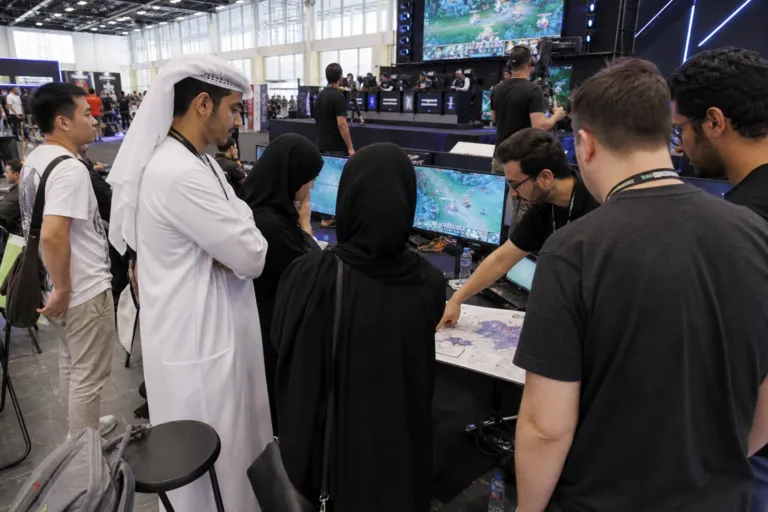
The Abu Dhabi gaming and esports market is best understood through the regional signals that surround it in the provided sources. Those signals connect gaming to tourism, infrastructure, and long-term investment. A Skift interview on gaming and esports tourism describes events where the draw is bigger than competition alone. It also frames gaming as a lever to “attract international audiences” and connect culture to youth movements. For Abu Dhabi, that matters because the city already positions itself around large-scale visitor experiences, including digital culture infrastructure that is permanent, not temporary.
Regional mega-events show what “scale” can look like when esports is treated as a destination product. Skift reports that in 2024, 180,000 people bought tickets to EWC tournaments, while 2.5 million visited for festival activities. The same source says the 2025 edition was the most-watched in the tournament’s history, with more than 750 million viewers and 350 million hours watched. It also says the event overall welcomed 3 million visitors to Riyadh. These figures are not Abu Dhabi-specific, but they indicate how audience and travel volumes can be driven by a gaming-led festival layer.
AD Gaming Strategy and Investment Map: What the Regional Benchmarks Imply
An “investment map” needs to include built assets and the policy posture behind them. Skift reports that Qiddiya City is building a gaming and esports district covering 183,100 square meters of arenas and facilities. Polygon adds explicit targets tied to the Qiddiya Esports and Gaming District: it aims to “attract 10 million visitors a year to its venues by 2030” and “incubate 30 leading video game development companies.” Polygon also describes a wider Saudi National Strategy for Gaming and Esports that aims to incubate 250 companies and contribute $13.3 billion to GDP, as cited to the PIF. These are external benchmarks, but they shape investor expectations and competitive narratives across the Gulf.
Abu Dhabi’s adjacent advantage in the sources is digital experience infrastructure that can complement gaming tourism. Artnet reports that Abu Dhabi unveiled teamLab Phenomena in Saadiyat Cultural District, described as a permanent 183,000-square-foot immersive complex. While that is not an esports arena, it reflects a market that invests in interactive, tech-driven visitor experiences. For an Abu Dhabi gaming and esports market strategy, that kind of permanent destination asset can sit on the same visitor journey as tournaments, festivals, and creator-led programming, without assuming any specific numbers beyond what the sources state.
Capital and consolidation signals also matter for Abu Dhabi’s investment map, even when the underlying deals are global. TechCrunch reports that Electronic Arts was nearing a $50 billion sale to a group of investors including Silver Lake and Saudi Arabia’s Public Investment Fund, citing The Wall Street Journal. The BBC adds that economic diversification is part of the rationale in the region and notes that it is estimated that 40% of Saudi Arabia’s wealth is from the sale of oil and gas. Together with PitchBook’s view that emerging markets are pushing toward 5% to 6% of global gaming revenue, these points frame why Gulf capital and policy attention remain focused on games, esports, and adjacent digital entertainment.
What does “Abu Dhabi gaming and esports market” mean in this article?
Which esports tourism numbers in the sources show the biggest scale?
What are the Qiddiya district and strategy targets mentioned that can benchmark Gulf ambitions?
What Abu Dhabi digital experience asset is cited that could align with gaming tourism?
What investment and macro signals in the sources suggest why the region prioritizes gaming?